Tuesday, September 20, 2011

Drinking Caesar’s Urine


Drinking Caesar’s Urine

By Bobby Neal Winters

My Burden

Every glass of water you drink contains a few molecules from Caesar’s urine.
There, I have shared my burden with you.  I first heard this myself more than 20 years ago.  A mathematician was talking in the faculty lounge.  He tossed it off, rocked my world, and then the conversation rolled along into other esoteric matters leaving me with this horrific bit of knowledge: I am drinking Caesar’s urine.  Between the period on the end of the last sentence and the “B” at the beginning of this one, I took a sip of coffee; more water, more of Caesar’s urine.
For years I was able to blot this out of my mind, but then it came back at me in the form of a question: how much?  How much of this rare liquid am I getting in every glass of water?  I am a mathematician, so I can do the calculations.  I did them.  The answer is 2100 molecules in every eight-ounce glass of aqua not-so-pura. The point of this essay is to explain how I arrived at that number and explore some of the territory along the way.
Making this calculation requires an assumption, so I will begin by explaining my assumption with the promise that later in essay I will return to justify it.  My assumption is this: Caesar’s urine is uniformly scattered throughout all of the water in the world.  That is a big one, but it is absolutely necessary to the calculation.  The calculation requires a simple formula—you  knew it was coming—that I will give below:
C=fG
Here C is the amount of Caesar’s urine in a glass of water, f is the fraction of the world’s water that is Caesar’s urine, and G is the amount of water in a glass. 
The value for f is one that we will have to calculate.  Here, I am going to limit the scope of my study.  I am only interested in the urine that Caesar excreted upon his assassination.  Calculating the amount of urine Caesar produced over his lifetime would introduce too many assumptions for my comfort-level which is going to be sorely tested in any case.  Consequently, I will focus on that one last bladder-full.  Here I am also having to make the assumption that Caesar had an average sized bladder and that bladder was full.
In any case, the average bladder has the capacity of 350 milliliters.  This is almost exactly the same amount of fluid in a can of Mountain Dew.  Coincidence?  I think not!
I am not too worried about this figure as it is something that I can verify for myself given soft drinks, time, and a calibrated beaker that I am not using for anything else.  Much more of concern is the next number I need, which is the amount of water available on the whole earth. This is a figure I had to look up: 1.36x10^9 km-cubed.  That is to say about one billion cubic kilometers.  This converts to 1.36x 10^21 liters. 
Doing the math—dividing the amount of urine in Caesar’s bladder  by the amount of water in the whole world—this gives us a figure of f=2.58x10^-22.
I have been using scientific notation here, which you might not deal with every day.  The figure for f is incredibly small.  Written out as usual, it would be
0.000000000000000000000258
I meant to have 21 zeros between the point and the 2.  You can count to see if I got it right.  In any case, you will agree that this number is small, so one might wonder at this point whether this whole drinking Caesar’s urine thing is plausible at all.  In order to justify this, I have to make a side trip to the world of the atom.

Avogad Row: The Place Where Chemists on the Skids Wind up

At this point, I get into an area where I don’t feel very comfortable: chemistry.  I never had a chemistry course in college.  I took one as a high school senior of which I only remember two things.  I learned the metric system for the fourth or fifth time and we put some aluminum in some nitric acid. 
Putting aluminum in nitric acid was really, really cool.  I spilled some of the nitric acid on my fingers and it turned them yellow and when we put the aluminum in the acid it got all hot and it looked like it might explode.  Learning the metric system for the fourth or fifth time was somewhat anti-climactic to this.  And come on, we get all of this hype of how the metric system is so much simpler than the so-called British system, but this why does it have to be drilled-in over and over and over.  When I went to college, I couldn’t stand that I might have to learn the metric system yet again, so I opted out of chemistry.  I took physics instead where the first thing they taught me was…the metric system.
I paid for this deficit in my education a few years back when I was made Acting Chair of the Department of Chemistry.  Among the things I learned there was that chemists are much more interested in blowing things up than they are in the metric system, but to blow things up in a predictable orderly way they must have an exhaustive knowledge of the metric system.  That is neither here nor there.
I need chemistry because I want to know how many molecules of water there are in a liter.  Chemists are interested in numbers of molecules because when they mix stuff together the proportions they mix are important.  The reactions go on at an atom-to-atom level. 
Chemists use a special unit to measure substances used in chemical reactions.  That unit is called the mole.  The mole is an odd unit because it is not a unit of volume nor a unit of mass, though in controlled circumstances it can be related to either of those.  Instead, the mole contains a fixed number of molecules.  That number is called Avogadro’s Number. 
Avogadro’s number is the number of molecules in 12 grams of pure carbon 12.  Carbon 12 is an isotope of carbon whose nuclei contain 6 protons and 6 neutrons giving it an atomic weight of 12, hence the name Carbon 12.  Does one get kind of a funny feeling about chemists here?  Do you get the impression they are strange sorts of ducks?  On one hand they have this mind-numbing obsession with the metric system and a total lack of imagination in naming their isotopes, but on the other hand they like to blow things up.
I’ve got all sorts of questions here.  Why carbon?  Why Carbon 12 in particular?  Why 12 grams of Carbon 12?  Were those two 12s chosen at random or is there more going on? Hmmm.  Were the Knights of the Templar involved?
I must put those questions aside to focus on the task at hand.  What is Avogadro’s Number?  Here it is:
                                               NA=6.022x10^23.
Again this is in scientific notation and that 10^23 in there means that if I were to write in out normally there would be 23 places between the 6 and the decimal.  In other worlds this is a big number.
As chemistry arose out of alchemy, I might doubt the veracity of number figured out by people who in their heart of hearts are still looking for the Philosopher’s Stone, but as they love blowing things up so much and this number is so important to that goal, I will accept it.

Aqua Pura

A trip to www.wolframalpha.com will assure us that a liter of water contains 55.5 moles of water, so a quarter liter will contain 13.875 moles and, therefore, 8.33x10^24 molecules.  The fraction of those which are Caesar’s urine is f=2.58x10^-22.  Multiplying these two numbers together rounds off to 2100, which is the number I gave at the beginning of the article.

Mixing

At the beginning of this article, we had to make the assumption that Caesar’s urine was scattered uniformly throughout all of the water in the world.  I promised that this would be justified later, and now is the time when the chickens come home to roost.
I will start with things you already know.  Rain falls from the sky onto the land; it trickles down hill into ditches, creeks, and streams; it gathers into lakes and rivers; it flows into the ocean; and at various points along the way it evaporates back into the air where it turns again into rain.  It is part of a cycle that has been going on for billions of years. 
Of course I’ve left out a few details such as at various places along the way folks—like Julius Caesar for instance—take a drink and then pee, putting it back into the cycle once again.
As a part of this system, many things happen to in and this is where mathematical modeling comes in. In the part of mathematics called Ergodic Theory, they model the behavior of such systems using a function called The Baker’s Transformation.  While this can be described in mathematically excruciating detail—and nobody knows about excruciating detail like a mathematician—you can think of it simply as follows.
A baker takes a ball of dough, stretches it to twice its width, gives it a quarter turn, and then folds it back over onto itself.  If you put a drop of red food coloring on this, it will eventually be spread uniformly throughout the loaf.
The idea is that similar things happen to Caesar’s urine.  It flowed onto the street where he lay dying; it evaporated into the air; wind sheared it and spread it around; and, after a suitable interval of time, it is spread out everywhere.
Mathematicians study strong mixing, weak mixing, and topological mixing depending upon the type of system they are interested in.  The Baker’s Transformation and Caesar’s urine are examples of strong mixing.

Conclusion

It occurs to me that some folks might find the prospect of drinking Caesar’s urine to be disturbing.  In that case, you probably shouldn’t dwell to long upon the fact that you are also drinking the urine of Caesar’s horse, his dog, and of the beggar who was lying on the street in front of Caesar’s house.  We live in an interconnected world.  I’m touched by people who lived thousands of years ago and thousands of miles away.  Those people (or should I say pee-ple) are literally a part of me.
As the author Norman Maclean said, “Eventually all things merge into one and a river runs through it.”
And that river will be carrying some of Caesar’s urine.  I just thought you should know.

Monday, August 22, 2011

The Shoulders of Giants

The Shoulders of Giants


And he made a molten sea, ten cubits from the one brim to the other: it was round all about, and his height was five cubits: and a line of thirty cubits did compass it round about.--1 Kings 7:23

The verse above frequently comes up in arguments between atheists and believers.  It implies that the value of the mathematical constant Pi is 3 as opposed to 3.14159... .
Some atheists use it as an example of a mistake the Bible which proves that the entire Bible is a lie and that, therefore, Christianity is a sham.  Believers, when they deal with this,  have been known to erect huge houses of cards in order to preserve the truth of the Bible on the atomic level.  
Let us put the polemics aside for the moment and just take a look as this issue.
Isaac Newton, the physicist and mathematician, is credited with saying that if he saw further it was because he’d stood on the shoulders of giants.  Newton had discovered the Law of Gravitation that bears his name along with the part of mathematics known as the Calculus and, in doing that, had benefited from the work of ancient Greek minds such as Archimedes along with the coordinate geometry of Rene Descartes, who had himself benefited from algebra that had come to the West from the Arabs.  
While the typical high school or college student might wish that these people, be they giants or not, had never existed, without them we would be without many of the modern amenities that we take for granted, particularly those amenities that require having satellites in orbit.  The mathematics is complicated but very useful.  It is also very beautiful.
Newton referred back to the geometry of the Greeks.  It is somewhat ironic that, although Newton did invent the Calculus and the Calculus is the way we prove Newton’s results today, he demonstrated them himself with synthetic geometry in the manner of the Greeks.  The Greeks mathematics for its own sake; they were interested in it for its beauty.  They pursued geometric truths because they found them to be beautiful.
Again, this is ironic because, when you are in the business of building a civilization, geometry is very useful.  If you are going to have a civilization, you will need at least one city to prove you are civilized.  That city will need palaces and temple and streets.  Geometry is necessary for the construction of all those things.  If your civilization isn’t going to starve, you will need a calendar  in order to keep track of time.  For a good calendar, you are going to need astronomy, and in order to do astronomy well, you are going to need geometry.
When the Greeks were doing geometry, they ran into the number Pi.  The number Pi, as you may recall, is defined to be the circumference of a circle divided by its diameter.  The word circumference comes from the Latin and obscures the Greeks referred to the circumference as the perimeter.  The word perimeter begins with the letter pi in Greek from there is it easy to see why we call it Pi.  
To me, it is an amazing fact that this ratio of circumference to diameter is the same regardless of whether the circle is ten inches across or ten miles across.  While my students have doubted my word on many things--in particular on the value of doing daily homework assignments--they’ve never doubted me on this thoroughly amazing fact.  The ratio of the circumference to the diameter of the circle is constant.
It is even more amazing that they believe this because it’s not true some other models of geometry.  Pi isn’t constant in either hyperbolic or spherical geometry.  You may have heard the old joke that if you tell people there are a billion-billion-billion stars in the universe they will believe you, but if you tell them the paint is wet they’ll have to touch it.
Pi is interesting mathematically because it’s an irrational number.  Irrational numbers are typically explained in school to be numbers whose decimal representation never repeats.  And that is true but it makes use of a way of expression numbers that was foreign to the Ancients.  The Ancients didn’t have decimals.  They didn’t really have fractions the way we have them. They worked with ratios.
A rational number is a number that can be expressed as a ratio of two whole numbers.  Pi cannot be expressed that way so it is irrational.  The Pythagoreans--those clever Greeks again--proved a result that in modern language and concepts boils down to the fact that the square root of two is irrational.  This is a comparatively easy exercise when one has modern notation. This irrationality of Pi does not have such an easy proof.
I’ve worked through a particular proof that Pi is irrational and satisfied myself that I understood every step and had a clear enough ideal of the “big picture” to present it to a class of seniors.  When I did this, they had the same expression on their faces as I presented it as my cat has when he watches me program the DVR.  It requires quite a bit of mathematical machinery and is not something the Greeks would’ve come up with.  The Greeks didn’t come up with anything else either.  
The Ancients, Archimedes among them, did come up with ratios that approximated Pi.  None of these was exact, of course, but only an approximation.  As I have said, there is no exact such ratio.
Let us now talk about the Biblical context in which this arises.  Solomon had hired builders from Tyre to built a temple to YHWH and while they were at it to build a house for him.  This is an interesting use of the word house as palace would be a better description.  This makes me think the PR people were already at work in those days.  This section of the Book of First Kings is describing the palace in what I as a reader consider to be excruciating detail.  In this, the passage has much in common with modern writing of the same type.
In any case, this molten sea is a round pool.  It is described as having a circumference of 30 cubits and a diameter of 10 cubits.  This would give us Pi=30/10=3, which we mentioned earlier.
From the modern point of view, this is redundant.  We know that when you give the diameter, you also give the circumference and vice versa.  The folks writing this description either didn’t know this or were wedded to redundancy.  Given the style of many of the drier patches of scripture, there is a case to be made for the latter, but I believe they just didn’t know.  Solomon had to hire this construction done.  Likely, they simply didn’t have the construction expertise available in Israel.  Without a well-developed practice of construction, they simply didn’t have the geometrical chops to know.
Now I would like you to do a thought experiment.  Act as if you are going to measure this yourself.  I would go to the hardware store and get a tape measure to measure the circumference and then measure the diameter.  I would have to use the tape measure because the pool is round.  Tape measures hadn’t been invented in those days and neither had hardware stores.  Likely they would have used a piece of cord and then measured the cord.  They would’ve measured it in cubits.
A cubit is an ancient form of measure that is based on the length of a man’s forearm.  I belief I am safe in saying that forearm length was as variable in antiquity as it is now, so in order for this method to be useful, they would’ve probably had to set a standard cubit at least for a given job.  That having been said, we can estimate the cubit to be about 18 inches.  This puts the pool at being about 180 inches in diameter.  Using the exact value for Pi, this would make the pool about 31 and a half cubits in circumference.  
In other words, the description given in scripture is about one and a half cubits off. In my mind, this was an amount that they would’ve noticed in the measuring.  They could’ve put down the correct number quite easily, I have to assume they didn’t because they just didn’t care.
They didn’t care because giving the correct value of Pi was not the purpose of this text.  I challenge you to read the seventh chapter of First Kings.  I double-dog dare you.
This text is about the opulence of Solomon’s Palace.  LIke the Russia in the cable TV commercial, Solomon could’ve said, “Opulence, I has it.”  Those of you who are Bible scholars know that Solomon taxed Israel to the point of ruin and his son finished the job.  In this text, you see part of where the money went.
Pi, schmi, Solomon had a swimming pool that was 15 feet across 47 feet around and seven and a half feet deep.  In a desert, if you got this you can say, “It’s good to be King!”
In conclusion, I’ve got to say that for me this is a non-issue, but I do understand there are those for whom it is. In my opinion, the Bible is not about Pi.  It is about the fact that we all stand on the shoulders of giants and that we should never forget that.

Thursday, July 28, 2011

The Laziness Index

The Laziness Index

By Bobby Neal Winters
I got a call the other day from my old friend Bubba back home.  He was being strangely thoughtful.
I often forget that Bubba received a college education because, I suppose, he so rarely gives any evidence of it.  The fact the of matter is that Bubba could always be quite successful at anything he wanted to do. He never suffered from a lack of IQ; it was more a deficit of “want-to.”
“So,” he began slowly, “you’ve heard of the heat index, haven’t you?”
“Yes,” I replied.  I’d heard a lot about it recently as it had been over 100 degrees and the heat index hand been exceeding that level of five or ten degrees. “We’ve been experiencing it directly.
“Well,” again he was approaching the subject with uncharacteristic care and thoughtfulness, “is it real or just something made up?”
“What do you mean?” I asked.  I am often not very sure where he is coming from, and, though I had an idea, there are times when it is just better to play dumb and ask questions.
“I guess I am asking if it corresponds to reality as described by modern physics or if is just something invented by the pretty talking heads they hire to report on the weather so they can get people to tune in and learn how miserable they are?”  Bubba can be pretty blunt.
“First of all,” I said, “not all of the folks who talk about the weather are all that pretty, and second some are pretty smart.  But to answer your question it is an attempt to capture something real.”
I went on to talk about the affect of humidity.  Humidity can have a tremendous effect on comfort. The human animal uses perspiration as a natural means of air-conditioning.  The sweat glands release water, i.e. sweat. 
When this water evaporates, it absorbs heat and that heat is moved away from the body.  In areas of high relative humidity, the rate of evaporation is slowed because there is a limit to how much moisture air can hold at any given temperature.
“There’s a formula for it, isn’t there?” he asked. “Do you know what it is?”
“There is a formula for it,” I said. “But I don’t know if off of the top of my head.”
“I thought you were a math teacher,” he said, sounding superior now. “What do you folks do if it’s not remembering formulas?”
He does this just to hector me.  In the past, I have attempted to justify my existence both as a mathematician and a teacher of mathematics, but I’ve never gotten anything to stick.  I’ve finally decided that he does this simply to annoy me, so, to avoid rewarding this behavior, I just ignore him.
“We do other things,” I said. “Besides it’s something I can look up anytime on the Internet.”
“What about wind chill?” he asked.  “Is there a formula for that too?”
“Yes,” I said, and, seeing where this was going, I added, “and I don’t know that one either because I can look it up any time.”
In my mind, I was being subtle.  I was attempting to plant the suggestion that, as he spends hours upon hours on the Internet surfing from Sasquatch site to Sasquatch site and finding the perfect fishing lure, he might be able to look this up himself.  I so easily forget that such methods are futile when dealing with Bubba.
“I’m glad to hear that you can look them up any time,” he said, “because I want you to look them up for me and explain them to me.”
I could see that I’d been out-maneuvered, so when we finished our conversation, I went to the Internet and looked the formulas up.
It turns out that, while the formulas are not sophisticated from the point of view of a mathematician, they are complicated from the point of view of the man-on-the-street--or the Bubba-on-the-dirt-road if you prefer. The formula for the heat index can be stated as follows:


The variable T stands for temperature measured in degrees Fahrenheit and R stands for relative humidity as a percent, i.e. 50 rather than 0.50.  The subscripted “a” variables stand in for particular values that I will now give below:


This formula involves no exotic functions, such as logarithms or the various trigonometric functions; it only requires addition, subtraction, and multiplication.  But it contains nine terms and the coefficients--the “a” variables--are decimals and some require scientific notation to represent.  In doing actual calculations with this formula, one would be well-advised to arrange his work carefully.  I myself prefer to put this sort of calculation in a spreadsheet.
The formula for wind chill is shorter, but it is a tad more exotic:
                                        

Again the T is temperature in degrees Fahrenheit while the V is wind speed in miles per hour.  The coefficients--the “b” variables--are decimals as given below:
                                                         

What makes it a little more sophisticated that the formula for heat index is that the V variable sports an exponent of 0.16.  This requires a special key on the calculator to evaluate, so it is no surprise that a spreadsheet is the best place to implement this calculation.
After looking these up and playing with them in a spreadsheet, I did a little report on it for Bubba and sent it off in an email. 
I was also careful to add that the heat index formula was only good for temperatures higher than 80 and the wind chill formula was only good for temperatures lower than 50. I think that may have been a mistake on my part, because it seemed to have turned Bubba’s thoughts in a particular direction.
My cell phone rang and the called ID read “Bubba.”  I took a deep breath, as has become my practice, and answered.
“Hello.”
“Those are some durned old complicated formulas there,” he said. “Can’t you come up with anything simpler?”
“They are what they are,” I replied.
“You know,” he was now getting thoughtful again, “The fact that the heat index only works above 80 degrees and the wind chill index only works below 50 degree got me to thinking that these formulas are just ways of telling you when it’s too bad to work outside.”
“That’s not a bad way to think about it,” I said.  Being a teacher, I always try to encourage thinking that is in the right direction.
“That made me wonder whether we might turn that around a little bit,” he said.
I was beginning to get nervous.
“Oh?” was all I could manage.
“Yeah,” he replied.  “I got to wondering whether maybe we out to figure out when it’s to good to work outside.”
“To good to work outside?” I was honestly confused.  “What do you mean?”
“Well, now, if it’s 70 degrees outside with a light breeze and there are a few clouds here and that and the fish are jumping, then I don’t want to waste a day like that on work.  I was wondering if you might could come up with a formula to say that.”
“What?”
“Yeah, you could factor in the temperature, the percentage cloud cover, whether the fish were biting, the price of beer...”
I cut him off.
“You know what?  I think the weather might be too good even now for me to work on that formula.”
“Maybe I could’ve figured that,” he said.
And we hung up.


Sunday, July 24, 2011

Foreign, sick science

Foreign, sick science

By Bobby Neal Winters
As I stood looking at the body on the table, waiting for Suzanna Doughcoup, our local homicide detective, to arrive, I began to examine my own character more closely.
Why do I find it so hard to say no when someone asks me for a favor?
Why is this especially difficult when it has something to do with mathematics?
Why do I even consider these things when it is something so far out of my area of expertise?
I could find no answers, at least none that I wanted to accept, but I will have to admit I don’t do my best thinking within the cold, antiseptic, rather creepy confines of a morgue. 
The call had come at 4am.  I staggered to the phone which is placed some distance from my bed.  As badly as I hate getting woken up by the phone, it is much worse when it is right by my head.
I don’t remember saying hello but I must’ve because the voice on the other end of the phone spoke to me.
“Hello,” it said.  It seemed to be vaguely feminine.
“What?” I replied.
“Hello,” the voice came back and called me by name.  “This is Detective Suzanna Doughcoup.”
“Who?” I asked.  I still wasn’t taking this in.
“Detective Suzanna Doughcoup,” she said. “I need your help to determine a time of death.”
“Death?” I was really doing rather badly. “Time?  What time is it?”
“It’s 4am,” Detective Doughcoup answered. “But that’s not important. What I need is for you to help me with a calculation of a time of death.  Will you do it?”
Four in the morning is really not a good time for me.  I get in some of my heaviest REM sleep in along about them.
“Do it?” I asked.  My inflection must have been off a little because I don’t think Suzanna heard the question mark on the end of that.
“Great!” she said.  “I will either come to get you or send a car.  That will take about half an hour.”
She hung up the phone.
I looked back at the bed which was beckoning to me.  It was singing whatever song Circe sang to Odysseus.  It was singing it quite well too.  I almost yielded to it, but I had a vision of Detective Suzanna Doughcoup battering down my front door and dragging me to the police station in my underwear. 
I pulled on my blue jeans, a t-shirt, and my tennis shoes.  Then I went to the kitchen and made a pot of coffee.  The coffee was done and I’d filled a thermos with it by the time I saw the squad car roll up.
It took the coffee time to perk, and, during that time, I got on the Internet to look up information on time of death calculations. During that brief interval of time, I was able to find five different ways of estimating the time of death: pallor mortis, livor mortis, algor mortis, rigor mortis, and decomposition.
 Pallor mortis is paleness and it begins fifteen minutes after death and lasts until two hours after death.  Livor mortis is a settling of the blood in capillaries in a way that causes purplish discoloration; maximum discoloration is 6 to 12 hours after death. Rigor mortis starts approximately three hours after death and lasts for approximately three days. I couldn’t even make myself look up the details on decomposition; Detective Doughcoup would strictly be on her own if decomposition were involved.
The remaining one, algor mortis, interested me the most.  Algor mortis is the cooling the body that follows death.  Using a mathematical formula, one can estimate the time of death.  I’d seen it on all my favorite detective shows, but I’d never had the occasion to look it up.
I thought that I knew how it was done. When I’d taught differential equations a number of years ago, I came upon Newton’s Law of Cooling, named for none other than Sir Isaac Newton.  As the story goes, an apple hit him on the head and he discovered Newton’s Law of Gravity.  I can only imagine that someone threw some cold water on him and he discovered the Law of Cooling.
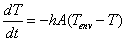
In plain language, it states that the colder the environment is than an object, the quicker the object cools off.  That sounds like common sense and it is common sense, but when you translate it into mathematics it looks more mysterious:
Here the thing on the left hand side of the equation that looks like a fraction is the rate of change of temperature with respect to time. 
On the right hand side, the h is a constant that depends on the physical substance being cooled. Metal cools quicker than wood, for example.
The A is the surface area that is exposed.  Something that exposes more surface area will cool more quickly than something with less surface area.
The

on the right hand side, represents the difference between the environmental temperature and the temperature of the object.  The colder the environment is, the quicker the object cooler.
Quite frankly, the possibility of applying this equation was making my mouth water.  The solution involved logarithms, and logarithms are cool. 
I will admit that logarithms get a bad rap in our popular culture.  In the movie An Officer and a Gentleman, one of the characters refers to them with a participle that begins with the letter “f.” In Roughing It, Mark Twain calls one of his not-too-bright traveling companions a logarithm.
I’ve been of the opinion that giving them the name “logarithms” was a huge marketing mistake.  They should’ve called them “happy numbers” or something, but I digress.
In any case, I’d gotten excited about the prospect of using logarithms and expected to see them in the formula used to calculate time of death.  Imagine my surprise when I find Newton’s Law of Cooling alluded to only in passing and am presented with the Glaisters Equation instead. 
The Glaisters Equation is:
On the left hand side, the little t is the time since death.  On the right hand side, the TR  is the rectal temperature of the cadaver.  I suppose it is hard to get them to put the thermometer under their tongue.
The taking of the temperature is the hardest part of this formula.  You subtract the rectal temperature from 98.4--I wonder why not 98.6--and divide by 1.5.
This is incredibly easy.  It is so easy that even Suzanna Doughcoup ought to be able to do it.  Upon her arrival, I had rehearsed the line that she could go to the Devil and that I would go back to bed.
There was a gentle knock on the door.  I opened it prepared to deliver what seemed to be a delicious line.
But it wasn’t her.  It was one of her loyal assistants who I knew would stay until I went with him.  I packed my line back up--along with my thermos of coffee--and got into the squad car with him.
It is only about five minutes from my house to the police station.  It’s not that I live particularly close to the police station; it’s just that nothing is more than about five minutes from the police station.
But, in those five minutes, I began to wonder about the simplicity of the Glaister Equation. It doesn’t take into account the environmental temperature and it doesn’t take into account the surface area of the body. Both of these are important factors in Newton’s Law of Cooling. 
As we got closer to the morgue, this worried me less and the rectal part worried me more.  I suppose that messing with a dead guy’s fanny is less awkward than messing with a live one’s as there would need to be fewer apologies afterward, but still: eeeewwww.
That last syllable was coursing through my brain when I set foot into the morgue and looked toward an autopsy table.  It was covered with the classic white sheet I expected, but there wasn’t nearly as much under that white sheet as I thought.
My first thought was “woman” because women are smaller.  But this was really small.  It was so small, in fact, and had such a shape that I shook my head in wonder at my earlier estimation of woman. 
I turned to the patrolman beside me.
“Armadillo?” I asked.
“Armadillo,” he confirmed.  He did so, amazingly, with a straight face. That straight face was put a lie to when he stepped out of the room and began to guffaw.
I stood there by the table asking why, why, why until Detective Doughcoup showed up.
“Glad that you could make it,” she said, “but I am sorry we don’t need you.”
“What?” I was to furious to go beyond monosyllables.
“Yep,” she said, “someone attempted to rob a liquor store and they ran over this armadillo when they made their get away. I thought that a time of death calculation would help establish the time of the crime, but then they told me the clerk had looked at his watch.”
I looked at my watch as a preparation for establishing her time of death, but decided I’d rather go back to bed instead.
“If you’d like to do it anyway, you are welcome to,” she said.
I looked at the thermometer and at the lump under the sheet.
“Take me home,” I begged.
“Have it your way,” she said.