Friday, July 20, 2012

What It Is


What It Is

By Bobby Neal Winters
We use science to study nature because we want to be able to predict; we want to be able to control.  We try to translate the language of nature to the language of man so that we can name the creatures of nature and thereby control them.
This, I am told, comes from an ancient tradition that we can see examples of in the Bible.  When Jacob wrestles with the unnamed entity in the night he asks the entity’s name and the entity is cagey about it.
When Moses is talking to God in the burning bush, he asks God for his name.  One would be reckless to try to even number the pages of commentary on the answer God gives.  In the Ancient tradition, it is left four consonants and is only pronounced once a year and only in the Holy of Holies.  Others have been bolder to translate it as “I am that I am” or “I am He who is.” Still others have said “I am all that is and was and will be.”  Perhaps one could even be so rash as to say “Being Itself.”
I leave it to you to ponder in your time alone when you are in the right mood how one might control Being Itself.
As we study nature and translate it into our own language, we create models.  The Ancients in studying health talked about the humors. I don’t mean to make fun of them.  When you look at a human, we are largely liquid.  They chose to classify that liquid as black bile, yellow bile, phlegm, and blood.  They used this language in order to make predictions and to attempt to exert some sort of control.
As I said, I don’t mean to make fun of this model.  Indeed, I think that, from a certain point of view, we still use this model.  Our body has various substances--chemicals--within it that can get out of balance.  Blood is still there and having the correct amount of it is still an issue, but the model has become more refined.  The blood has other substances within it that can become out of balance:  hormones, sugar, salt, etc.  There is a huge industry devoted to trying to keep these modern humors in order. This is useful.  It does allow us to make predictions and to exercise a certain amount of control.
The danger we danger we face is in confusing the model--our name for the thing--with the thing itself.  I am thinking specifically here of the photon, the fundamental particle of light.  Indeed, thinking of the photon was the impetus of this essay.
The question goes back again to the ancients, way before Isaac Newton, but I will mention Newton because he did a lot of research on light.  He thought that light was made of corpuscles, often imagined as little billiard balls, and he used his ideas and mathematics to make accurate predictions and to exert control.  He invented the reflector telescope.  
There were contemporaries of Newton, Robert Hooke and Christian Huygens, who proposed a wave theory of light and imagined light a wave in the ether, whatever ether might be.  The wave theory didn’t gain wide acceptance until the 1800s when other scientists were able to make accurate mathematical predictions themselves.  
Students in introductory science classes might rightly be confused because so much of the time the teacher doesn’t bring it to closure.  So is the photon a little billiard or a wave in the ether.  Inquiring minds want to know.
Here’s the answer: A photon is a photon.
It has some properties that can be modeled by thinking of it as a tiny, little, teeninsy billiard ball and others that can be modeled by thinking of it as a wave in the non-existent luminiferous ether.  It is what it is.
These models, these “names” we give the thing in our own language enable us to devise mathematical gadgets that we can manipulate to make predictions and exert control.  These are useful, sometimes shockingly so.
But we ought not confuse them with the thing itself which might very well be unknown and unknowable; uncontrolled and uncontrollable.

Friday, July 13, 2012

Trefoils, Borromean Rings, and Athanasius


Trefoils, Borromean Rings, and Athanasius

By Bobby Neal Winters
You can look up in church windows and see them.  They are the Trefoil Knot and the Borromean rings.  I learned about them first as mathematical objects rather than religious ones because I grew up in a religious tradition that did not truck with such abstract notions.  
**
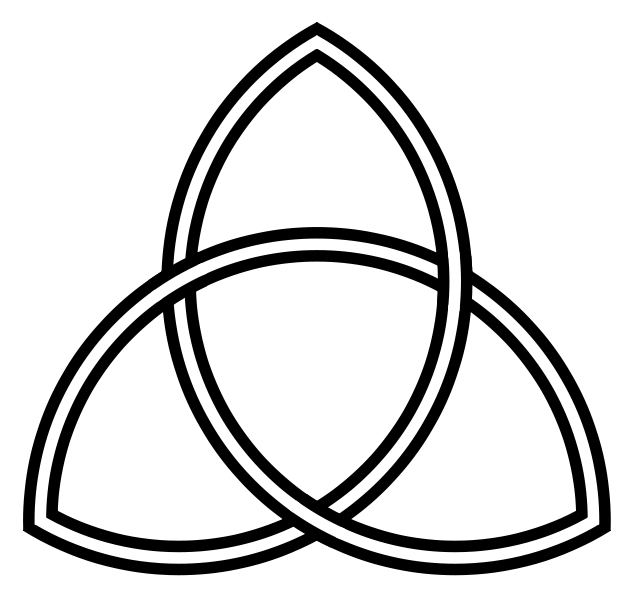
Trefoil Knot
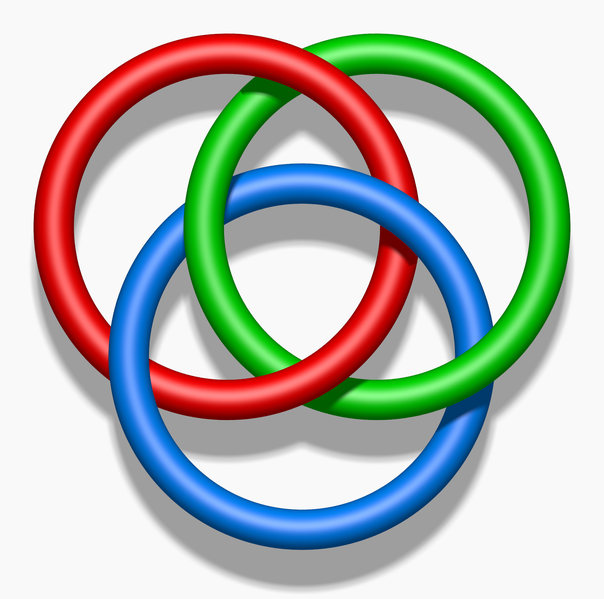
Borromean Rings


But as abstract as they are, the Trefoil Knot and the Borromean Rings are more concrete than the religious concepts they were trying to capture.  I learned about them as I was working on my doctorate in the area of low-dimensional geometric topology.  Specifically, I was beginning the study of knot theory.  My two main sources on knot theory in those days were an article “A Quick Trip through Knot Theory” by Ralph Fox and a wonderful book called Knots and Links by Dale Rolfsen. These were my Old and New Testaments, but not necessarily in that order.
Once while I was working on my doctorate, I had a conversation with one of my cousins with regard to what I was studying him.  I told him about knot theory.  His intelligent middle school aged daughter was listening and interrupted with an indignant tone.
“That isn’t math!” she said.
It leaves that impression with a lot of people.
Knot theory, like her great great grandmother Geometry, attempts to describe the visual world with words. She sees and then she describes.
Let us take the Trefoil as an example.  From the topological point of view, it is a circle. Put your finger on it and trace around it.  It comes back around on itself and starts over.  You can keep going around and around forever just like a circle.  There is a difference, though.  When you draw a standard circle, the lines never do, but in drawing a Trefoil there will be places where the lines cross.
When knot theorists draw the trefoil, we avoid letting the lines touch.  We imagine the Trefoil as being in space and the crossing as being a place where the trefoil passes behind itself.  We draw the part that passes behind as broken.
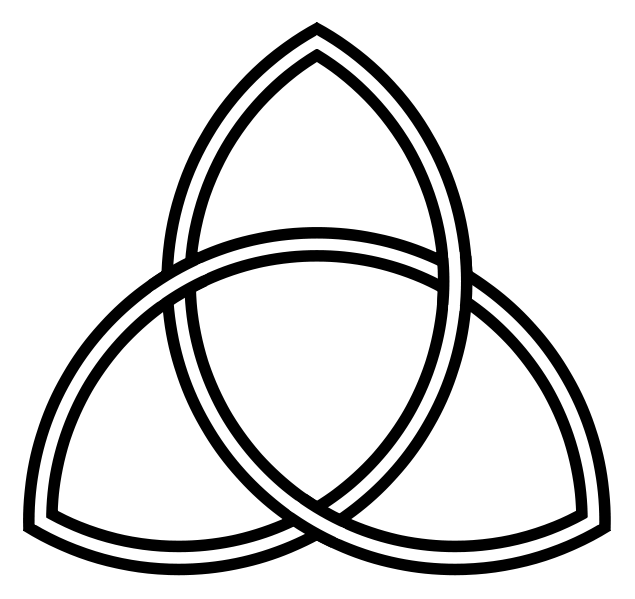
The Trefoil Knot is the simplest (non-trivial) knot.  Knot theorists can draw it many different ways, but the way one sees it in the church window is probably the best.
*
The Trefoil Knot


It exhibits a three-fold  symmetry.  Note that there are four finite regions that the knot bounds: One is in the exact center and the other three are distributed around it. If you rotate the picture around the center of the middle piece by one third of a rotation, each of the other three pieces will lay exactly on one of the others.  They are completely equal in size and shape.
This three-fold symmetry is something the Trefoil has in common with the Borromean Rings.
*
The Borromean Rings

The Borromean Rings are an example of a link.  Links and knots are inextricably interrelated.  (This is to avoid saying they are linked. While I don’t object to puns in general, this one is too cute.)   Links are groups of knots that are...uh..linked to each other.  The Borromean Link is special in that each of its pieces (components they are called) is a simple unknotted circle and if any of the circles is removed the rest falls apart, i.e. becomes unlinked.
The question one might ask, because of how I began this article, is why are these religious symbols.  Why do they appear in church windows? They are, of course, symbols of the Trinity.
I once asked a dear friend of mine to explain the Trinity.  I asked him because: one, he has a master’s degree in theology so he is learned in these things, and, two, he is Catholic and they just know this stuff.  He talked to me for ten minutes.  Every sentence he said made sense; they piled one upon another in coherent paragraphs.  At the end of the discourse he said, “And if you understood what I just said, then you weren’t paying attention.”
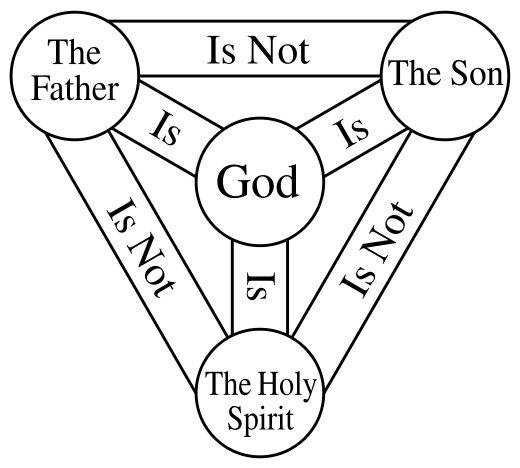
The Trinity is not something those explain the faith would’ve made-up simply help sell it better.  One can easily infer oneself to misunderstands such as Jesus is his own father.  One can find the concept in the Athanasian Creed or one can refer to the diagram below:
*
The Relationships among the Persons of the Trinity

The Trefoil and the Borromean Rings provide a comparatively concrete example of how something can have three parts and still be one thing. They provide a way to defuse the easy quasi-numerical arguments against Trinitarian faith.
The strength of mathematics lies in its exactness.  There is a quote by Roger Bacon that I know because I play Civilization IV, not because I read. It is: "If in other sciences we should arrive at certainty without doubt and truth without error, it behooves us to place the foundations of knowledge in mathematics."  This certainty comes because in mathematics we are able to create an artificial world that is an approximation in some way of the real one.  We may then extrapolate from the artificial one in order to approximate the real one. Nature leaves a footprint; scientists take a cast of it; mathematicians draw a sketch of the cast.
Mathematics is Man’s extension of his language in an attempt to capture the language of Nature.  I almost said “Reality” instead of “Nature,” but that would carry the implicit assumption that Nature and Reality are the same.  I find that assumption to be farther and farther from obvious as I grow older.  Maybe it’s Alzheimer’s.
As a person of faith, I believe things exist beyond those I can touch.  I suppose this is part of being a mathematician.  We create worlds that at first seem to exist only in our own heads, but, as we interact with other of our kind, we discover they have created those very same worlds in their heads as well.  
Christian theologians found themselves heirs to millennia of tradition and scripture.  From that they distilled the concept of the Trinity. We might at this point recall the reaction my cousin’s daughter had to Knot Theory: That is not Mathematics.
While theology is certainly not mathematics, we might have even more sympathy for the theologian than for the knot theorist.  While the knot theorist is attempting to use language to capture the visual world, i.e. what we can see, the theologian is trying to use language to capture what we can’t see. Optimistic might be one adjective to describe such people; insane might be another.
But I don’t want to dismiss them.
I find something good in staring at a stained glass window being reminded that there are things I don’t understand and never will and that no one else will either, but that we still desire to strive toward understanding.

Wednesday, June 13, 2012

Wednesday, April 18, 2012

You Can Count on It


You Can Count on It

By Bobby Neal Winters
I’ve been revisiting an old friend this semester, or should I say and old opponent; when you get older sometimes the two are the same.  This isn’t a man or a woman.  It’s a book: Topology by J. R. Munkres.  I could quote Heraclites here and it would be half true.  Even though it is a second edition, the part of the book I covered in class hadn’t changed.  I have.
I only have a tithe of the energy I had in 1983 when I took the course from this book, and my mind is not as quick as it was in days of old.  I do, however,have almost 30 more years of experience now so my energy is focused better.  It’s like the joke told about the old bull and the young bull.  
The young bull said, “Let’s run down the hill, jump over the fence, and breed a couple of those cows.”
The old bull countered this, “Let’s walk down the hill, go through the gate, and breed all of those cows.”
It’s about planning and priority.
I suppose my lower energy level makes my mind go more slowly. I pause over ideas I would’ve pushed on by before.  I try to get the point of what I understood only on a technical level before.
Recently my mind has been focusing on the concept of the uncountably infinite.
Infinity is one of those concepts we really don’t get even when we “get it.” There is a gestalt of a sort when we play games with children asking them to name the biggest number they can.
“A thousand million billion trillion zillion,” they say.
“I can name a bigger one,” you reply.
“Uh, uh,” they reply.
“Oh, yeah,” you return. “What about a thousand million billion trillion zillion plus one?”
You better be careful doing this, because if they don’t have the gestalt the game can go on a long, long time.
Uncountability goes beyond this game of always being able to add one to get a bigger number.  It is a stranger critter.  
The first kind of infinity we encounter is the infinity of the so-called natural numbers, the numbers we use for counting: 1, 2, 3, and so forth.  Sets that can be listed out, each element having a unique natural number for a label, are said to be countably infinite. We can count the numbers and will eventually get to every one of them even if there will never be a time when we counted all of them.
Look back at the last sentence.  If you’ve read it carefully and are not a mathematician, you may feel a little green, but it’s written as I meant to write it.
A set is uncountable if you can’t list them in such a way that you will eventually get to each particular one of them.  This can all be put in precise, technical language, I assure you.
Don’t make me do it.
To show that an uncountable set exists, all one has to do is construct a set all of whose elements can’t be listed.  My favorite such set is the set of all sequences of zeros and ones.
A sequence is a list itself.  A sequence of zeros and ones would be like the following: 1,0,1,0,0,1,0, 0, 0, and so forth.  Note that here I’ve attempted to make something with a pattern.  First a 1 and then one zero; then another 1 followed by two zeros; then 1 followed by three zeros.  Continue in this way.  These sequences needn’t have a pattern.  I could have a sequence: 1,1, 0, 1,0, 1,1,1,1,0 and so for with no pattern.  These sequences would be different.
Now I claim that it is impossible to list out all sequences like this even if the list goes on forever.  The way I show that making this list is impossible is through the method of proof by contraction.  I assume that I can but the show there is always at least one left over.  
Assume there is such a list.  Then make another sequence of zeros and ones whose nth item disagrees with the nth item on the nth list.  Such an element is clearly not on the list and since the list was assumed to be exhaustive there is a contradiction.
You say you could just put it on top of the list.  I say, “Bah! By your own lying words you claimed if was already there! Die you varlet.”
Sometimes doing this stuff makes me sound like I am talking to a pirate.  Let’s just push on.
What I am going to say now will sound strange.  What else is new?  Anyway, I like this example because it is so concrete.  Seriously.  It is just lists of zeros and ones.  School children can make lists of zeros and ones.  I appreciate this now, better than when I was a kid those three decades ago, because of a theorem from Munkres I am going to teach my students tomorrow if they don’t derail class by bringing donuts or something, which is a constant risk with these youngsters.
The theorem states that if a topological space is compact and Hausdorff and contains no isolated points then it is uncountable.
You are no doubt saying to yourself, “Make sense to me.”
Okay, let me gloss that a bit.  A topological space is a set with structure: its open sets.  Compactness is a technical condition that gives us a certain type of control.  Hausdorff, other than being the German work describing a dorff belonging to a particular haus, is a condition that gives us another sort of control.  Again, I could make this even less readable by rolling out the technical definitions, but my point is these are simply abstract conditions, as is the condition of having no isolated points.
It is at the opposite end of the abstractness spectrum of our example of the set of sequences of ones and zeros, but, and here is the kicker, the spirit of the proof is the same.  You assume the points of the space are in a list and then construct a point that is not in the list.
Shazam!
More interesting yet is the fact that--if I had a taser and another semester with these kids--we could use the same technique to prove the Baire Category Theorem which, to mind young, energetic mind of three decades ago was not related to either of these results.

Saturday, March 17, 2012

Arithmetic, Calculators, and Work


Arithmetic, Calculators, and Work

By Bobby Neal Winters
Let me start out by saying that I am not now and never have been any good at arithmetic. Something goes wrong in my brain when I trying to multiply number two numbers together. I do have a good memory and I can remember things like 5 times 5 is 25 and 25 times 5 is 125 and 5 times 125 is 625.  And I can use this to remember that one-half is 0.5, one-fourth is 0.25, one-eighth is 0.125, and one-sixteenth is 0.0625.
But this is something that I’ve learned from years of teaching mathematics. For most things, I resort to a calculator and have since they were invented.  Yes, young people, if there are any of you out there, I am that old.
I am so helpless with arithmetic, that I am the reason my high school accounting teacher, Mr. Billy R. Scott,  began the practice of allowing his students to use calculators.  Yes, I am that bad.
Needless to say, I’ve allowed students to use them as long as I’ve been in front of the classroom.  True, many of the classes I teach are so theoretical that calculators are of dubious value, but I allow their use anyway.  
And to tell you the truth, I’ve not really worried about it very much for the last 29 years. Yes, I have been teaching math for that long because, yes, I am that old.
But recently there’s been a problem.  Student’s are having problems reading their calculators.  You see, here’s the thing about calculators: you’ve got to learn how to use them.
When I teach now, I tell my students to develop a loving, mutually supportive relationship with their calculators.  You can’t just ignore it for a month and expect it to perform for you on the morning of the test. You only get out of it what you put into it.
Seriously.
Even though I was a bust with arithmetic, I could make a calculator sing.  I could do things with it that the folks who made it didn’t know about.  Back in those days, and maybe yet, teachers put questions on tests that required arithmetic that the calculator couldn’t do like exact answers with no decimals.
I could do those on the calculator because I was that good.  I was that good because I spent time on it. Somehow, the chicks didn’t dig it, though.
You wouldn’t dream of waiting to the day of recital to play your piece on the piano for the first time; you wouldn’t think about climbing behind the wheel of a car for the first time on the day of the test for your license; why would you even think about not turning on your calculator until the day of the test?
I look back at that and see the bit about the recital.  There are a lot of student’s who’ve not had that experience.  I never did. I only think of it because my kids--my middle-class kids--have. They’ve had recitals and calculators and computers.  They’ve had parents harping at them to practice as well, and I do know that you can hear parental harping at a distance, even from beyond the grave.
Many of the students I teach haven’t had any of those things.  This isn’t an excuse.  They’ve got an opportunity to go to college now and it’s my job to be a navigator.  
I chose that metaphor pretty carefully.  Students have to do the work themselves.  They have to care themselves. I can’t work for them.  I can’t care for them.
I can navigate them along a path that I’ve followed successfully myself. I can mark the finish line. They have to run.

Sunday, February 19, 2012

Notions of Sameness

Notions of Sameness
By Bobby Neal Winters
Mathematicians use sets and structures on sets to model realities that they perceive only in their minds.  I dealt with this in the matter of topology in one of my recent essays.  These structures induce special properties that we want to preserve.  I am still interested in this mainly in the case of topological spaces, but I will work my way up to it via a series of examples from other areas of mathematics.
The first example is that of sets with no structure in which we can only discuss the concept of cardinality.  This is to say, how many elements does a set contain?
With finite sets we can say that a set is composed of five elements or seventeen elements or two trillion five hundred fifty four billion two hundred twenty seven million three hundred twelve thousand five hundred and two elements.  There is a number we can associate with them.  
For infinite sets, the above does not work; we have to do a flanking maneuver. We avoid the word number and use the term cardinality.  We say that two sets have the save cardinality if they can be put into one-to-one correspondence with each other.  
We use the language of functions to make such notions precise.  Functions are thought of as having a sending set (the domain) and a receiving set (the range).  The range is like a target.  When two sets have the same cardinality, there is a function from one set to the other that is one-to-one and onto.  A function is onto if every point in the receiving set is matched with a point in the sending set.  A function is one-to-one if no set in the receiving set is matched twice.
A function that has both of these properties at once is christened with the high-falutin’ label of bijection.  It’s technical and pretentious but remember it anyway because it’s important.
If two sets have a bijection between them, they have the same cardinality.  If one (and therefore the other) of those sets is finite, they will also have the same number of points.  By this mathematical slight of hand of using a particular type of function to create a new notion of “sameness” we’ve expanded the notion of number/size into the notion cardinality/size.
This is done in the realm of algebra as well.  And here I must be careful because I am using the word “algebra” differently than many use it.  If you had pre-algebra and algebra in middle and/or high school, or if you have had intermediate algebra or college algebra in college, then rest assured that I am talking about something that is related to that in the way that a Tomahawk Missile is related to, well, a tomahawk.
Algebraists, and I am over-simplifying, study sets with binary operations on them.  For example, they might study the real numbers with the operation of addition or the positive real numbers with the operation of multiplication.  (Notice I put the word “might” in there because they aren’t really interested in those two particular sets, but I will use them because I don’t want to talk about a lot of algebra now.)
The real numbers numbers with addition and the positive real numbers with multiplication are examples of groups.  Groups are sets with binary operations that obey certain rules.  Don’t worry about what those rules are; if you can’t help it, look it up on Wikipedia.
Those of you who have had a course in college algebra might remember the logarithm.  I put emphasis on the word might there because I’ve no doubt that you have seen the logarithm.  You might remember it; you might wake up in cold sweat screaming it at the top of your lungs; your lover might have attempted to comfort you afterwards asking, “What is a logarithm, Sweet heart?” only to have you deny ever having heard the word.
In any case, the logarithm is a function from the positive real numbers to the real numbers that is bijective, i.e. it is one of those important one-to-one correspondences.  The important thing about it is that it changes the operation of times to that of plus: log(a times b) is equal to log(a) plus log (b). In mathematical ages B.C.--before calculators--the logarithm was used as a means of doing multiplication by turning it into addition.  You may not have notice, but addition is a lot easier than multiplication.  
Such a function that is bijective and preserves the operations on the groups--in this case turning multiplication into addition--is called an isomorphism.  The groups are said to be isomorphic to each other and a mathematician in the capacity of algebraist can’t tell the difference between them.
I could go on listing the various areas of mathematics and the functions they use to preserve there important concepts, but instead of doing that let me focus on topology.
A topological space is a set along with certain special subsets that we call “open” sets.  Topological concepts are those concepts that can be defined in terms of open sets.  As a consequence of this, we are interested in functions that preserve open sets.  A bijective function between two topological spaces that takes an open set in the first to an open set in the second is called a homeomorphism.  A pair of spaces between which there is a homeomorphism are said to be homeomorphic.  Spaces that are homeomorphic are the same as far as a topologist is concerned.  
Most frequently, I see homeomorphisms defined differently.  We usually define a homeomorphism to be a continuous function which is invertible and whose inverse is continuous.  This is mathematically equivalent to the other definition I’ve just given, but it’s shorter.  
Continuous functions are interesting in their own right.  Indeed, one might argue that topology was created in order that we might better study continuous functions.  There is also quite a well-developed theory of continuous functions that allows us to check whether a particular function is continuous.  For example, it is quite easy to use calculus to check that the logarithm and its inverse the exponential function are both continuous; it might be less easy to show they preserve open sets.
But in our desire to be efficient with our definitions, we should take care not to obscure for the beginner the very thing that homeomorphisms do: they preserve open sets.  As they preserve, nay set up a one-to-one correspondence between the open sets of each space, any properties defined in terms of open sets will be preserved.  That is the point.

Friday, February 3, 2012

Sets with Structure

Sets with Structure

By Bobby Neal Winters
This semester I am teaching a course in topology after a hiatus of six years.  I am using a classic text by James R. Munkres with the title, fitting enough, Topology. This is the text I had my graduate level course from.  It’s been like meeting an old friend again after an extended separation.  Only someone who’s done that can appreciate all of the levels of meaning.
Topology is a word-like every word now that I think of it--that carries a bundle of meanings.  On the level that is most accessible to a popular audience, it is understood to mean that branch of mathematics in which a coffee cup is no different than a phonograph record. (That’s a CD to you, you young whipper-snappers!) For the sake of precision, we could make a distinction by saying geometric topology or even low-dimensional topology, but in practice clarifying adjectives or adjectival phrases get stripped off and we are left with topology left alone, forced to hide the other meanings it carries.
Today, I would like to venture into one of those areas where angels fear to tread to talk about the subject that mathematicians (especially geometric and low-dimensional topologists) refer to as general or point-set topology.
One can could say that low-dimensional topology is a sub-speciality of general topology, and I will justify the sense in which that is true in the sequel, but such a statement blurs over differences of mindset among the various practitioners.
Let me say I was drawn to my first topology course having seen the pictures of coffee cups being blithely changed into phonograph records, donuts, etc, only to find something entirely different.
A course in general topology begins with a topological space.  A topological space is about as abstract a concept as the math major will meet as an advance undergraduate or beginning graduate student.  It is a set which is paired with a special collection of its own subsets, and this special collection of subsets have a set of laws they must obey.  I won’t tell you now no matter how much you beg me.  We give a name to that special collection of subsets and call it a topology.  I told you the word carried a bundle of meanings.
The most common example of a topological space is the set of real numbers.  Topologists who’ve just read that sentence are now picking up pencils from their desks to write in “with the usual topology” between the “s” in the word numbers and the period that follows it.  I left it out on purpose just to annoy them because it is the usual topology. It is based on the open intervals that students learn about as early as middle school.  The open intervals are used to construct open sets and the set of all of the open sets of the real numbers is the usual topology on the real numbers.
The usual topology on the real numbers is such a natural thing to us--and my “us” I mean “geeky math types”--we don’t even notice that it’s there.  We use the real numbers with the usual topology first in calculus and later in analysis, and I have talk these courses without ever uttering the word topology.  Most of the basic results in those areas can be reached without naming the topological concepts explicitly.
Perhaps the concept of a topological space would never have been created had mathematicians not ventured beyond the real numbers, but--you know those scamps--they did.  They ventured into the plane, into 3-space, into sets of functions, and so forth, and they discovered sets of subsets in each of those areas that behaved like the open subsets of the real numbers behaved.
If I knew more of the history of the subject, this would be an opportunity to segue into a case study in abstraction.  Those three examples I listed above have quite a bit of structure on them.  They have ways of doing arithmetic, they have ways of measuring angles, and they have ways of measuring distance. They are groups; they are vector spaces.
When we push out to the level of abstraction required by the topological space, we forget about all of that other structure.  You can’t do arithmetic; you can’t measure distances.  You think about only the set and its topology.  You only define properties that can be discussed in terms of the members of the topology.  You only discuss functions which respect the members of the topology.
In some sense, learning general topology first requires that you forget everything else you know about anything. You become a slow thinker; you become a deliberate thinker; you always must be careful that your intuition--raised as it was in the fertile fields (nerdy pun fully intended) of the real numbers--does not lead you astray.
This sort of abstraction allows us to prove theorems that apply to a wide range of areas. It allows us to create language to see an underlying unity in diverse areas of knowledge.  It also provides a trap-door into what has been referred to as centipede mathematics, as in “How many legs can I pull off the centipede before it can’t walk any more?”
I called it a trap door, but I am not sure that metaphor works.  It makes what happens sound like an accident.  The truth is more complex.  Many--most--who are drawn into mathematics find this sort of abstraction attractive, not to say intoxicating.  Going deeper and deeper into abstraction leads us into what our appetite desires.  It is like the wind buoying up our wings, lifting us farther and farther from the ground.  Here the story of Icarus is attractive, but also inaccurate.  We don’t go so high that the sun melts our wings; we are lifted so high we are never seen again.
There is a quote I’ve heard attributed to RH Bing, a Texas mathematician who is a personal hero of mine.  When asked about a visiting topologist, he is said to have replied, “He studies spaces of which there are only one example and only in England.”
Mathematics, especially abstract mathematics, is best when it is equipped with numerous examples. Examples give breadth and richness.  Examples guarantee you aren’t just proving theorems about the empty set.  But I digress.
General topology is alive with examples.  It is wide and it is deep.
There was a time in my career, and I will say this without shame, that I taught subjects simply because I wanted to learn them myself, without regard to the student.  I say it without shame because the students can still get a lot of value from that provided they are motivated themselves and their needs are being regarded other places.  Time has dealt with me in any case. I find myself singing along with Bob Seger:

Well those drifter's days are past me now
I've got so much more to think about
Deadlines and commitments
What to leave in, what to leave out

As I teach my courses now, I try to focus on what I think the student needs.  One great need that students have as they enter into graduate mathematics is to have their pre-assumptions stripped away. The abstractness of general topology is the best method I know.  That having been said, there is so much of it. What do I leave in?  What do I leave out?
In the end, my prejudice is to choose topics that will lead my students toward areas where mathematics is growing, places where many branches come together, places where there is structure--much structure. Then they will be able to choose.