Showing posts with label Knot Theory. Show all posts

Friday, July 13, 2012

Trefoils, Borromean Rings, and Athanasius


Trefoils, Borromean Rings, and Athanasius

By Bobby Neal Winters
You can look up in church windows and see them.  They are the Trefoil Knot and the Borromean rings.  I learned about them first as mathematical objects rather than religious ones because I grew up in a religious tradition that did not truck with such abstract notions.  
**
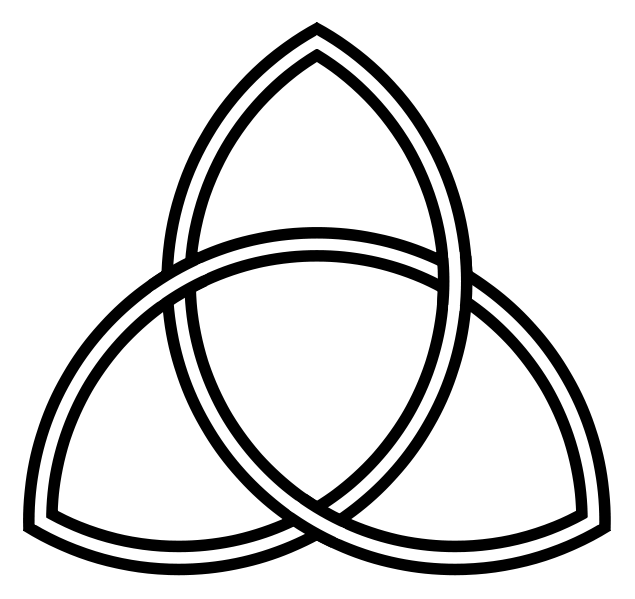
Trefoil Knot
Borromean Rings


But as abstract as they are, the Trefoil Knot and the Borromean Rings are more concrete than the religious concepts they were trying to capture.  I learned about them as I was working on my doctorate in the area of low-dimensional geometric topology.  Specifically, I was beginning the study of knot theory.  My two main sources on knot theory in those days were an article “A Quick Trip through Knot Theory” by Ralph Fox and a wonderful book called Knots and Links by Dale Rolfsen. These were my Old and New Testaments, but not necessarily in that order.
Once while I was working on my doctorate, I had a conversation with one of my cousins with regard to what I was studying him.  I told him about knot theory.  His intelligent middle school aged daughter was listening and interrupted with an indignant tone.
“That isn’t math!” she said.
It leaves that impression with a lot of people.
Knot theory, like her great great grandmother Geometry, attempts to describe the visual world with words. She sees and then she describes.
Let us take the Trefoil as an example.  From the topological point of view, it is a circle. Put your finger on it and trace around it.  It comes back around on itself and starts over.  You can keep going around and around forever just like a circle.  There is a difference, though.  When you draw a standard circle, the lines never do, but in drawing a Trefoil there will be places where the lines cross.
When knot theorists draw the trefoil, we avoid letting the lines touch.  We imagine the Trefoil as being in space and the crossing as being a place where the trefoil passes behind itself.  We draw the part that passes behind as broken.
The Trefoil Knot is the simplest (non-trivial) knot.  Knot theorists can draw it many different ways, but the way one sees it in the church window is probably the best.
*
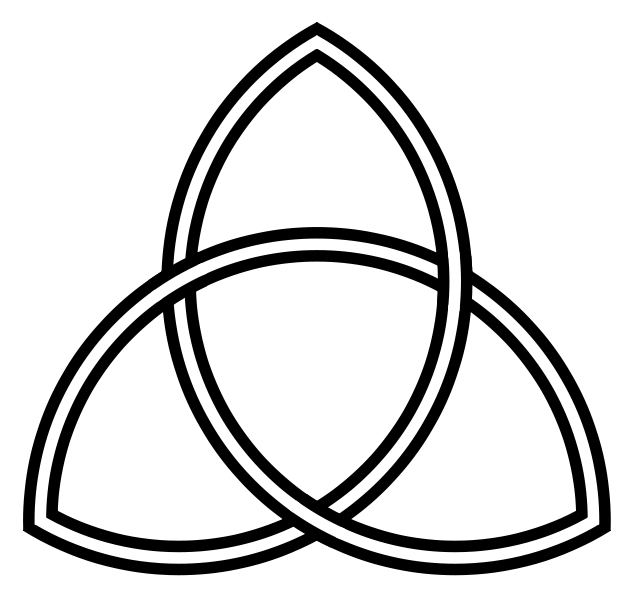
The Trefoil Knot


It exhibits a three-fold  symmetry.  Note that there are four finite regions that the knot bounds: One is in the exact center and the other three are distributed around it. If you rotate the picture around the center of the middle piece by one third of a rotation, each of the other three pieces will lay exactly on one of the others.  They are completely equal in size and shape.
This three-fold symmetry is something the Trefoil has in common with the Borromean Rings.
*
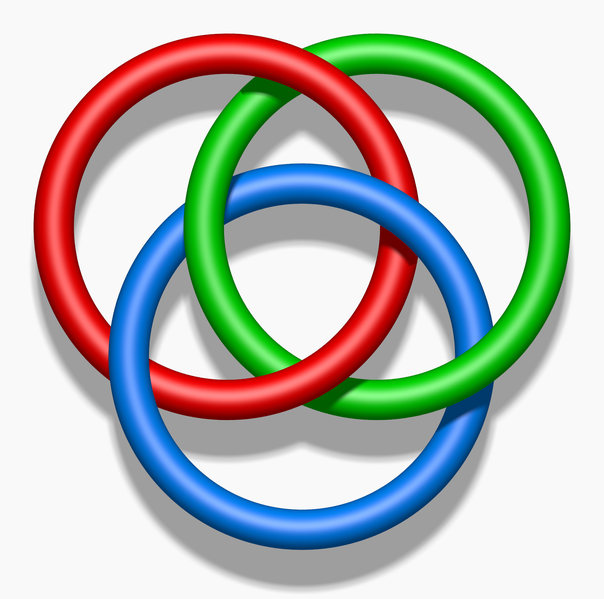
The Borromean Rings

The Borromean Rings are an example of a link.  Links and knots are inextricably interrelated.  (This is to avoid saying they are linked. While I don’t object to puns in general, this one is too cute.)   Links are groups of knots that are...uh..linked to each other.  The Borromean Link is special in that each of its pieces (components they are called) is a simple unknotted circle and if any of the circles is removed the rest falls apart, i.e. becomes unlinked.
The question one might ask, because of how I began this article, is why are these religious symbols.  Why do they appear in church windows? They are, of course, symbols of the Trinity.
I once asked a dear friend of mine to explain the Trinity.  I asked him because: one, he has a master’s degree in theology so he is learned in these things, and, two, he is Catholic and they just know this stuff.  He talked to me for ten minutes.  Every sentence he said made sense; they piled one upon another in coherent paragraphs.  At the end of the discourse he said, “And if you understood what I just said, then you weren’t paying attention.”
The Trinity is not something those explain the faith would’ve made-up simply help sell it better.  One can easily infer oneself to misunderstands such as Jesus is his own father.  One can find the concept in the Athanasian Creed or one can refer to the diagram below:
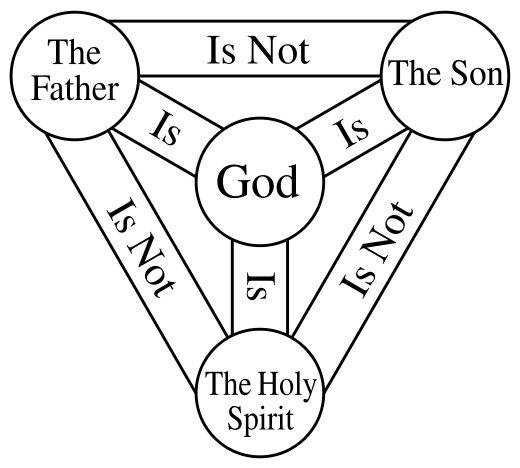
*
The Relationships among the Persons of the Trinity

The Trefoil and the Borromean Rings provide a comparatively concrete example of how something can have three parts and still be one thing. They provide a way to defuse the easy quasi-numerical arguments against Trinitarian faith.
The strength of mathematics lies in its exactness.  There is a quote by Roger Bacon that I know because I play Civilization IV, not because I read. It is: "If in other sciences we should arrive at certainty without doubt and truth without error, it behooves us to place the foundations of knowledge in mathematics."  This certainty comes because in mathematics we are able to create an artificial world that is an approximation in some way of the real one.  We may then extrapolate from the artificial one in order to approximate the real one. Nature leaves a footprint; scientists take a cast of it; mathematicians draw a sketch of the cast.
Mathematics is Man’s extension of his language in an attempt to capture the language of Nature.  I almost said “Reality” instead of “Nature,” but that would carry the implicit assumption that Nature and Reality are the same.  I find that assumption to be farther and farther from obvious as I grow older.  Maybe it’s Alzheimer’s.
As a person of faith, I believe things exist beyond those I can touch.  I suppose this is part of being a mathematician.  We create worlds that at first seem to exist only in our own heads, but, as we interact with other of our kind, we discover they have created those very same worlds in their heads as well.  
Christian theologians found themselves heirs to millennia of tradition and scripture.  From that they distilled the concept of the Trinity. We might at this point recall the reaction my cousin’s daughter had to Knot Theory: That is not Mathematics.
While theology is certainly not mathematics, we might have even more sympathy for the theologian than for the knot theorist.  While the knot theorist is attempting to use language to capture the visual world, i.e. what we can see, the theologian is trying to use language to capture what we can’t see. Optimistic might be one adjective to describe such people; insane might be another.
But I don’t want to dismiss them.
I find something good in staring at a stained glass window being reminded that there are things I don’t understand and never will and that no one else will either, but that we still desire to strive toward understanding.

Sunday, January 4, 2009

A Knotty Problem

Treasurer forever?

When I was in college and declared as a mathematics major, my advisor told me, because of this, I would be treasurer of every organization I belonged to. This is, of course, because people associate mathematics with numbers. Take out a little time an say "Duh" at this point. Everybody does. For 99 percent of the population, the bulk of there experience with mathematics is numerical, i.e. with numbers.

My advisor was right, of course, I have been put to use as a treasurer in at least one organization I belong to, but arithmetic was never my forte, and, if arithmetic were the only part of mathematics I'd been exposed to, I'd likely done something else. But in the 10th grade, I was exposed to geometry and the notion of proof and the love affair between mathematics and myself began.

Incorrect pictures

Geometry has been called the art of correct reasoning from incorrect pictures. I include this not only because it's a great quote, but because it captures an important bit of what modern professional mathematicians do. We explore things that we "see" within our skulls and we try to explain what is special about them. The trouble that occurs when we reason with pictures is that there might be something special about the picture that we are using that would disappear is we drew the picture in a slightly different way. Pictures lie. (As that fictional TV physician Gregory House says, "Everybody lies.") A mathematical proof is no place for a lie. Therefore, pictures are avoided whenever possible. This view is held with almost religious fervor.

Two languages
In geometry, the cause for my love affair with mathematics, you can see how this might be a problem. It is a problem, and it is dealt with in a couple of ways: synthetic geometry and analytic geometry.

Synthetic geometry goes at least back to Euclid. As you know, geometry deals with lines and planes and points, oh my! When I say the word geometry to you and then say line and point and plane. You know exactly what I am talking about. These are terms from your experiences, so, likely as not, you've got images of them in your mind. When we are talking about synthetic geometry, however, these are what are known as "undefined" terms, which makes it more than a little odd that Euclid had definitions for them, but the Greeks did a lot of strange things. Don't get me started. In any case, Euclid then described how these undefined objects interacted with one another.

I mention this not out of my tremendous love for geometry but because it illustrates a principle. We begin with objects that we have experience with; we abstract them into objects whose existence is beyond the physical; then we create a language in which we can discuss them.

In analytic geometry, we translate geometry into the language of algebra. More people have deeper experience with analytic geometry than with synthetic geometry because analytic geometry is the language of calculus.

One truth needs to be made clear before the reader proceeds to the rest of this essay or to the rest of his life. Synthetic geometry and analytic geometry are not enemies. Indeed, there is no more enmity between them than there is between a hammer and a monkey wrench. Each is a tool with its own function. One can use a monkey wrench to hammer nails and one can use a hammer to loosen a stubborn nut 'tis true. This has been done with the two approaches to geometry as well, but I will let that thread go.

Knot theory
When I went to graduate school, I learned first hand than there was more to mathematics than arithmetic or geometry or algebra. There was something called analysis that was like calculus but with more theory and less calculation; there was something called algebra but which was as unlike what I learned in high school as a grizzly bear is from a teddy bear; and there was something called topology.

I liked topology. It was like geometry but it was floppier. I eventually did my doctorate in topology. Connected with topology, but somehow separate from it was another subject that I found interesting. It is called knot theory.

The alert reader will no doubt've guessed that knot theory deals with objects from our own common experience: knots. But the alert reader should also, no doubt, be suspicious that maybe what I mean when I say knot is not the same as what he means when he hears knot. Is that clear or is it not? Or knot? These aren't your scoutmaster's knots, fella. These are mathematical abstractions of those. One main difference, beyond just the abstraction, is that in knot theory the knots are closed curves. For example, your scoutmaster might've taught you how to tie this:


But in knot theory we would closed off the end like so:


Knot diagrams
The alert reader that I mentioned earlier is sitting in his reading chair with his hand waiving furiously in the air saying "Ooh,ooh, ooh, teacher, you said mathematicians didn't like reasoning with pictures!"

My answer is "Well, ooh, ooh, ooh, this isn't reasoning with pictures. It is describing with pictures, and, while one must be circumspect in using pictures in any case, it is allowed."

One of the ways we are circumspect is by only allowing certain ways in which knots can be presented. The most common way to present a knot, and the way we did it above, is to use a knot diagram. You may have heard that dancing is a vertical expression of a horizontal idea. Well, a knot diagram is a two-dimensional version of a three-dimensional idea.

Let me explain it to you this way. Drawing is hard. This is why you've got a fellow like Leonardo Di Vinci being famous for being able to draw a winning smile. Very few mathematicians can compete with Leonardo, but don't tell them I said that because they are very sensitive. Knot diagrams were designed so to make the act of drawing a knot as simple as possible. The idea is to draw the knot as if it had been laid on a table top. There are places where the knot crosses itself. Where that happens, we put a magnifying glass over the crossing so as to ignore everything else. Under the magnifying glass, we see only to strands of string. One of those is on top and the other is beneath it. We draw the one that is on top as an unbroken line and the one on the bottom as a broken segment. Examples of these are as below:


Everywhere else, away from the crossings, the various strands of the diagram don't cross, of course. If you experimentally construct a knot from string--which is not too difficult to do--and experiment by placing it upon a table in different ways, you will make the discovery that the same knot can have a variety of different diagrams. Our first example of a knot and the example immediately below is an example of a pair of different-looking diagrams coming from the same knot.


Another one would be


Basic questions

One of the basic questions with which knot theorists busy themselves is whether two different knot diagrams might, in fact, represent the same knot. This is a question which the current space and tone prevents a full answer. However, I can tell you that if two diagrams represent the same know that one can be changed to the other by the use of Reidemeister Moves. There are three Reidemeister Moves which mathematicians using all the of the marketing flair for which they are so well-known have named the First, Second, and Third Reidemeister moves. Indeed those charmers have made use of well-known sexiness of Roman Numerals to refer to them as Reidemeister moves I, II, and III.

Reidemeister Move I is pictured below.


This represents pretty much what it looks like, i.e. someone taking a piece of the knot between index finger and thumb and giving it a twist.

We now consider Reidemeister Move II


This portrays taking one piece of the knot and sliding it over another. Move III as we now see is a little more complicated.


This involves taking one strand and moving it past the point where two other strands cross.

As I said, if there are two diagrams of the same knot, then one can be changed to the other by doing (or undoing) these moves in various combinations. Knowing that you can do it and doing it are different things, as they say.

Getting philosophical

To go much further at this point would require me getting technical, and I don't think that's something we want to do here, eh, Bubba? But the point is that we can impose a language upon a geometric situation and use that language to reason in a precise way.