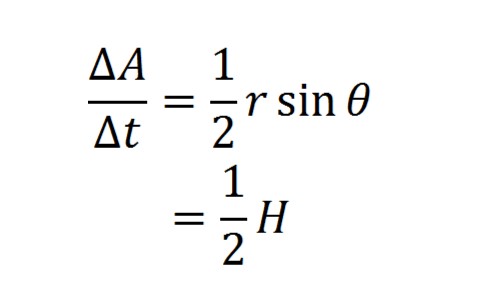
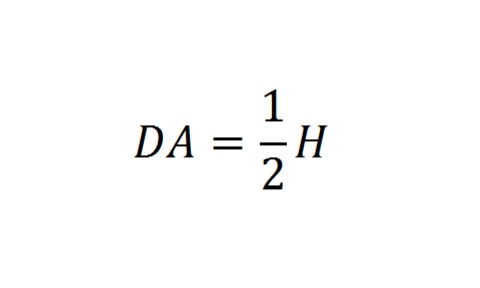
Angular Momentum and the Cross Product
The physical concept of angular momentum is a key piece of our approach to the derivation of Kepler’s Laws. Let us begin our study of angular momentum with a thought experiment. This thought experiment is low-tech enough for you to carry out in your backyard, if you should so desire.
In an ill-fated attempt to teach me the basics of hitting a baseball, my father created the following device: He put a tennis ball in a sock and tied the sock to the end of a cord. He then swung it around his head. Even when he stopped moving his arm, the ball persisted in a roughly circular path for a time. This persistence was caused by angular momentum. (We will ultimately replace the ball by a planet and the string by the sun’s gravity.)
There are three things that affect the tennis ball’s angular momentum in this system: its mass; its distance from the center of rotation; its velocity. Mathematically this is captured in an equation that I will first give and then carefully explain
The variable $\vec{L}$ denotes the angular momentum itself. Note that it is a vector. Its direction is the axis of rotation of our tennis ball. The variable $m$ stands for mass, of course; it will enter into our calculations surprisingly little. The vector $\vec{r}$ goes from our center of rotation to the tennis ball, as it were. It will vary in magnitude and direction as it gives us the position of the moving object. The vector $\vec{v}$ denotes the velocity of our tennis ball. It is the derivative of $\vec{r}$ with respect to time.
Within this formula, you will notice the symbol $\times$, the cross product. It is very tempting to give a full treatment of it here, but I will resist that temptation. Instead, I will give a simple definition; a list of the results we need; and refer the interested reader to any decent calculus text.
Given vectors $\vec{Y}$ and $\vec{Z}$, we define a third vector $\vec{W}$ whose magnitude is equal to
where $\theta$ is the angle from $\vec{Y}$ to $\vec{Z}$. The vector $\vec{W}$ lies in a line that is mutually orthogonal to $\vec{Y}$ and $\vec{Z}$ and has a sense so that the triple $\vec{Y},\vec{Z},\vec{W}$ preserves the right hand rule.
Let us now consider vectors $\vec{A},\vec{B},\vec{C}$. We will need the following pair of formulas in the sequel. The first is called bac-cab:
where $\cdot$ is the familiar dot product. The second is called the scalar triple product:
We will also be taking derivatives. I will, for the most part, eschew both the Newtonian and Leibnizian notation. Instead, $D$ will denote the taking of a derivative with respect to time. So $\vec{v}=D\vec{r}$, for example. The usual product rules for differentiation hold for both the dot and cross products:
We will, as far as we can, try to follow the convention of using the plain letter to denote the magnitude of a vector, i.e. $r$ is the magnitude of $\vec{r}$ and $v$ is the magnitude of $\vec{v}$. However, $a$ will never denote the magnitude of $\vec{a}$: the former is the length of the semimajor axis of an ellipse; the latter is acceleration. This will not cause any confusion.
Let us now return briefly to
As the magnitude of $\vec{L}$ is
we can think of $v\sin \theta$ as being the portion of the velocity that is perpendicular to $\vec{r}$. This will be useful at a crucial moment.