Showing posts with label Newton's Law of Gravity. Show all posts

Sunday, January 3, 2016

Calculating Orbits: Kepler’s First Law

Kepler’s First Law

Kepler’s First Law tells us that planetary orbits are ellipses.  The following derivation, taken from Wiesel, is very clever: it solves a second order differential equation as if by magic.  We begin with our second order differential equation, which is an expression for the acceleration of a planet taken from Newton’s Law of Gravity:
We will now cross each side of this equation on the left with the vector $\vec{H}$:
Consider the left side of this equation and note the following
because $\vec{H}$ is constant with respect to $t$.
Now consider the vector portion of the right hand side
By the bac-cab formula
Clearly, $\vec{r}\cdot\vec{r}=r^2$.  It is also true that $\vec{r}\cdot\vec{r}=rDr$.  This is clear when we resolve $\vec{v}$ into a coordinate system in which $\vec{r}$ lies along one of the axes.  It follows that
Therefore,
It is at this point in the derivation that the god comes out of the machine.  Note
so
which can be written as
Therefore, the vector whose derivative we’ve taken is constant.  Choose the vector $\vec{e}$ so that
and as a consequence
There is yet another god in the machine, however.  Dot both sides of this equation with $\vec{r}$ so that
By the application of the triple scalar product, the left hand side may be transformed as follows

If we let $\nu$ be the angle between $\vec{r}$ and $\vec{e}$, the right hand side becomes
Therefore,
and consequently,

Saturday, January 2, 2016

Calculating Orbits: Kepler's Second Law

Kepler’s Second Law

Our aim is to derive Kepler’s Second Law:
The radius from the sun to the planet sweeps out equal areas in equal times.
To put this in language better suited to mathematical manipulation, let $A$ denote the area swept out from time zero to time $t$.  Then Kepler’s Second Law saws $DA$ is a constant.  We shall show that not only is it a constant but a constant with meaning to physics.
In this derivation, we shall have occasion to use a formula derived from Newton’s Law of Gravity:
The acceleration of a planet is inversely proportional to the square of the distance from the sun and is directed toward the sun.
Mathematically:
or
So
as the angle from $\vec{r}$ to itself is zero and so $\sin \theta =0$.  Thus,
Let us also observe that
So that $\vec{r}\times\vec{v}$ is constant.  We will denote this constant by $\vec{H}$ and note that
where $\vec{L}$ is angular momentum.  We can think of $\vec{H}$ as being angular momentum per unit mass.
Now consider the following diagram of our two-body system as time $\Delta t$ has elapsed.
For small $\Delta t$
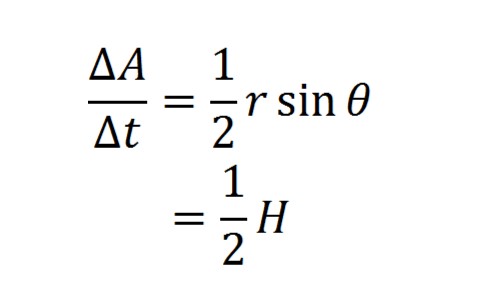
so that the altitude of this triangle is $v\sin \theta$ where $\theta$ is the angle from $\vec{r}$ to $\vec{v}$,  If $\Delta A$ is the area of this triangle, then
so that
where $H$ is the magnitude of $\vec{H}$.
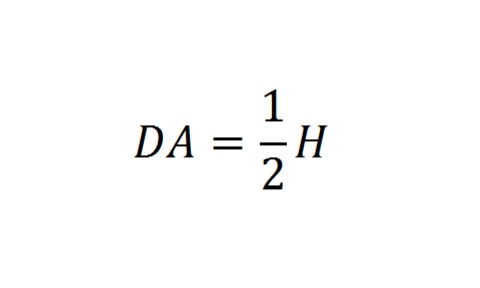
Therefore,

which is Kepler’s Second Law.