Showing posts with label Kepler's Second Law. Show all posts

Monday, January 4, 2016

Calculating Orbits: Kepler’s Third Law

Kepler’s Third Law

Kepler’s Third Law relates the period of revolution of a planet, denoted by $T$, to the semimajor axis of the orbit of that planet, denoted by $a$.  The square of $T$ is directly proportional to the cube of $a$.
We know that the rate of change the area swept out by a radius is constant so
Our derivation consists of finding the appropriate expressions for $A$ and $DA$.  Recall that
and
We have the final form for $A$ but will have to work a while more on $DA$. In doing this, we will find an expression for $H$ that is more meaningful to the geometry of an ellipse.
Consider the orbit equation derived in a previous section:
In the ellipse below, we have picture the point in the orbit of the planet when $\nu=\frac{\pi}{2}$. This is when the segment $SP$ is perpendicular to the major axis of the ellipse.
Let $p$ be the length of the segment $SP$.  So $p=\frac{H^2}{\mu}$ from the equation for $r$ with $\nu=\frac{\pi}{2}$.
We may compute $p$ another way from the ellipse below:
By the Pythagorean Theorem
and solving this for $p$ gives us
so
Therefore,

and so
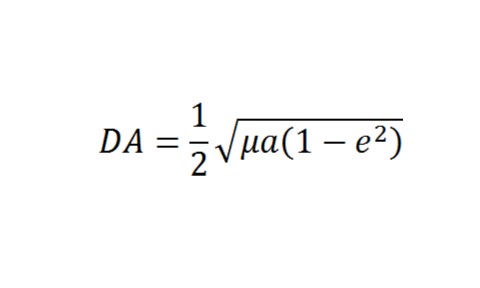
Therefore,
so that finally we have Kepler’s Third Law

Saturday, January 2, 2016

Calculating Orbits: Kepler's Second Law

Kepler’s Second Law

Our aim is to derive Kepler’s Second Law:
The radius from the sun to the planet sweeps out equal areas in equal times.
To put this in language better suited to mathematical manipulation, let $A$ denote the area swept out from time zero to time $t$.  Then Kepler’s Second Law saws $DA$ is a constant.  We shall show that not only is it a constant but a constant with meaning to physics.
In this derivation, we shall have occasion to use a formula derived from Newton’s Law of Gravity:
The acceleration of a planet is inversely proportional to the square of the distance from the sun and is directed toward the sun.
Mathematically:
or
So
as the angle from $\vec{r}$ to itself is zero and so $\sin \theta =0$.  Thus,
Let us also observe that
So that $\vec{r}\times\vec{v}$ is constant.  We will denote this constant by $\vec{H}$ and note that
where $\vec{L}$ is angular momentum.  We can think of $\vec{H}$ as being angular momentum per unit mass.
Now consider the following diagram of our two-body system as time $\Delta t$ has elapsed.
For small $\Delta t$
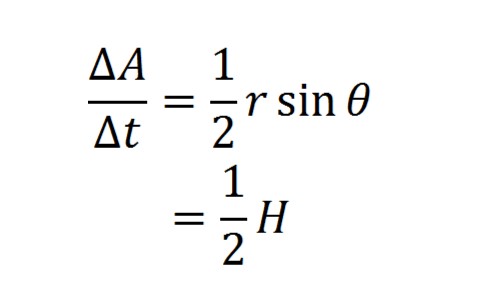
so that the altitude of this triangle is $v\sin \theta$ where $\theta$ is the angle from $\vec{r}$ to $\vec{v}$,  If $\Delta A$ is the area of this triangle, then
so that
where $H$ is the magnitude of $\vec{H}$.
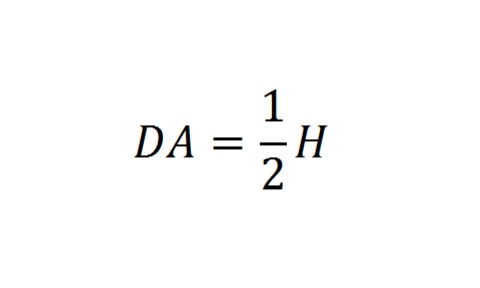
Therefore,

which is Kepler’s Second Law.