Saturday, October 26, 2019
Next week, no algebra, I promise
By Bobby Neal Winters
I have made a mistake. Worse than that, I have made a mistake in print. Please let me explain.
Last week my column was about how 57 is not a prime number and how I know. I talked about tests for divisibility by 2, 3, 5, and--most to my current point--7. The first three tests are widely known and, in my day at least, were taught in primary school. You might not remember them, but they were.
The test for divisibility by 7 was new even to me, and I hadn’t worked with it much. Indeed, working on that column was the first time I’d ever applied it, so, of course, I applied it wrong.
Rather than show you what I did wrong again, let me explain it correctly this time. Let us take a number, say 149, and determine whether it is divisible by 7 by this test. I chose 149 because I know that it is not. There is an easy way that doesn’t use this test, but I don’t want to muddy the water.
Take the number and remove the last digit, 9. This leaves 14. Now take 14 minus 2 times 9 (which is 18). This 14 minus 18 is -4, which is not divisible by 7, so 149 is not divisible by 7.
Let’s make it a little harder. Consider 358. Note that 35 minus 16 is 19 and that 19--being prime--is not divisible by 7.
How would this have worked with the number 57 that we used last week? Well 5-14 is -9 which is not divisible by 7, so 57 is not divisible by 7 either.
Now I seriously doubt that anyone caught my error because in the era of calculators and computers, very few people worry about arithmetic anymore. No one would’ve looked at it much because newspapers disappear having an afterlife of lining dresser drawers or wrapping fish.
An obscure local columnist such as myself can reasonably hope his mistakes might disappear with the Wednesday trash pick-up. Even with columns on the internet, what we write might live forever, but it does so like the Ark of the Covenant in a giant warehouse.
I seek to correct my mistake for a couple of reasons. The first of which is my education as a mathematician. We are so boring, if we aren’t right, then what are we good for? The second is I would like to model what I consider proper behavior is when a person makes a mistake.
If you make a mistake, you should ferret it out yourself, before anyone else has a chance to do it, and own it. Don’t double down on it: Own it. Everyone makes mistakes.
If you don’t catch it first, do the same thing: Own it.
When I found the test for divisibility by 7, I was in a hurry and I didn’t read it carefully enough, so I misinterpreted it. I compounded this mistake by not proving the result myself. What did Ronald Reagan say? Trust but verify!
I trusted the Internet, but I didn’t verify.
For those of you who have hung in this long, let me now prove the result. It is a simple proof, but it will take some algebra, so it you aren’t in the mood for algebra, I will see you next week.
When I say remove the last digit of a number, I am saying take a number of the form 10x + y where x is any positive integer and y is an integer between 0 and 9. When you remove the last digit. This leaves you with x. Then the number you get by subtracting 2 times the last digit is x - 2y.
We say that 10x + y is divisible by 7 exactly when x - 2 y is. How do we know this is true. Well (10x + y) minus 10 times (x - 2y ) is 21y. Now 21y is definitely divisible by 7. It follows from this that (10x+y) is divisible by 7 exactly when (x - 2y) is. This is because 10 is not divisible by 7.
See, simple.
Next week, no algebra. I promise.
Bobby Winters, a native of Harden City, Oklahoma, blogs at redneckmath.blogspot.com and okieinexile.blogspot.com. He invites you to “like” the National Association of Lawn Mowers on Facebook. )

Sunday, August 4, 2019
8÷2(2+2)
8÷2(2+2)
By Bobby Neal Winters
It is a rare day when a bit of mathematics is in the news, and it is an even rarer one when it is a bit that experts and laypersons can talk about with equal confidence, equal accuracy, and be equally wrong.
Today is one of those days.
This is because the 8÷2(2+2) meme has been going around the Internet. It is a corker to be sure. Is it 16? Is it 1? Is it a communist conspiracy?
Well, as with all such things we should treat it as a teachable moment and in several directions. The first thing if ought to say is that if you type it into a computer program interpretive interface, like the IPython console, for instance, it will give you 16 every time.
This is not a definitive answer, however, because dealing with computer input and output is HARD and allowances have been made. It has been a special case since computers came into existence and there have been multiple methods of dealing with it. One of these was quite good and it was called Reverse Polish Notation (RPN), and if you ever owned an old-fashioned HP programmable calculator in the eighties, then you’ve used it. As you may have guessed, there is something called Polish Notation (PN) as well that has been used in dealing with computer input. It would take us too far afield to discuss either of these, but there are nice articles on Wikipedia that discuss both.
Whenever I get to teach Elementary Statistics, I use an Excel spreadsheet for some applications and I’ve learned that dealing with multi step calculations can be confusing, so I teach coping mechanisms as I go along. We approach them with care because everything has to be typed in in a linear fashion and we can’t use all of the methods that mathematicians standing in front of a blackboard or writing in longhand on a piece of paper have at their disposal.
This brings me to something that has bothered me since the first time I saw this meme: The used of the symbol ÷ for division. I haven’t used it in years. You cannot find it on a computer keyboard. To type this into a computer, you write 8/2(2+2). When I see this, the ambiguity pops right out at me. I would teach students to write either (8/2)(2+2) or 8/(2(2+2)) so that the problem goes away. That ÷ symbol was put in there on purpose to make a point.
My dad was a truck driver and truck drivers have a saying about the right of way in driving: He was right, but he dead right. As a mathematician, I need to keep that sentiment alive. If you follow the order of operations (parenthesis, exponentiation, multiplication division, addition, subtraction) you will get 1. However, you can’t count on computers do that; you can’t count on people walking around on the street to do that; therefore, you need to order your mathematical communications in such a way as to be as unambiguous as possible.
So I’ve answered the first two questions, 16 if you are a computer and 1 if you are a mathematician, what about the third, is it a communist conspiracy?
Maybe not communist, but the use of the ÷ symbol makes me believe there is something going on here that requires a bit of technical sophistication. I had to look up how to get my computer to do that symbol. Maybe it is easier for others, I will be open to learning that, but I had to use [control][shift]uf7 to get Google Docs to do it. Its use in this meme not only hides the ambiguity of this expression from professional mathematicians, it makes the question accessible to people who’ve had no exposure to mathematics beyond eighth grade arithmetic. Is this good? Is this bad? I don’t know, but it is interesting.
Perhaps I am sensitive to this because there is a fairly steady stream of anti-mathematics education memes that go around in social media. They hate the new methods of teaching subtraction; they hate the common core; they think we should stop teaching algebra all together and teach how to balance checkbooks instead (that is not an either or, by the way, we do both, but the second we don’t do in math class).
So the final lesson that should be taken away from this is that we who teach math can’t ignore this. We must engage it in some way.
So the answer to 8÷2(2+2) is that we need to talk.
Bobby Winters, a native of Harden City, Oklahoma, blogs at redneckmath.blogspot.com and okieinexile.blogspot.com. He invites you to “like” the National Association of Lawn Mowers on Facebook. )
By Bobby Neal Winters
It is a rare day when a bit of mathematics is in the news, and it is an even rarer one when it is a bit that experts and laypersons can talk about with equal confidence, equal accuracy, and be equally wrong.
Today is one of those days.
This is because the 8÷2(2+2) meme has been going around the Internet. It is a corker to be sure. Is it 16? Is it 1? Is it a communist conspiracy?
Well, as with all such things we should treat it as a teachable moment and in several directions. The first thing if ought to say is that if you type it into a computer program interpretive interface, like the IPython console, for instance, it will give you 16 every time.
This is not a definitive answer, however, because dealing with computer input and output is HARD and allowances have been made. It has been a special case since computers came into existence and there have been multiple methods of dealing with it. One of these was quite good and it was called Reverse Polish Notation (RPN), and if you ever owned an old-fashioned HP programmable calculator in the eighties, then you’ve used it. As you may have guessed, there is something called Polish Notation (PN) as well that has been used in dealing with computer input. It would take us too far afield to discuss either of these, but there are nice articles on Wikipedia that discuss both.
Whenever I get to teach Elementary Statistics, I use an Excel spreadsheet for some applications and I’ve learned that dealing with multi step calculations can be confusing, so I teach coping mechanisms as I go along. We approach them with care because everything has to be typed in in a linear fashion and we can’t use all of the methods that mathematicians standing in front of a blackboard or writing in longhand on a piece of paper have at their disposal.
This brings me to something that has bothered me since the first time I saw this meme: The used of the symbol ÷ for division. I haven’t used it in years. You cannot find it on a computer keyboard. To type this into a computer, you write 8/2(2+2). When I see this, the ambiguity pops right out at me. I would teach students to write either (8/2)(2+2) or 8/(2(2+2)) so that the problem goes away. That ÷ symbol was put in there on purpose to make a point.
My dad was a truck driver and truck drivers have a saying about the right of way in driving: He was right, but he dead right. As a mathematician, I need to keep that sentiment alive. If you follow the order of operations (parenthesis, exponentiation, multiplication division, addition, subtraction) you will get 1. However, you can’t count on computers do that; you can’t count on people walking around on the street to do that; therefore, you need to order your mathematical communications in such a way as to be as unambiguous as possible.
So I’ve answered the first two questions, 16 if you are a computer and 1 if you are a mathematician, what about the third, is it a communist conspiracy?
Maybe not communist, but the use of the ÷ symbol makes me believe there is something going on here that requires a bit of technical sophistication. I had to look up how to get my computer to do that symbol. Maybe it is easier for others, I will be open to learning that, but I had to use [control][shift]uf7 to get Google Docs to do it. Its use in this meme not only hides the ambiguity of this expression from professional mathematicians, it makes the question accessible to people who’ve had no exposure to mathematics beyond eighth grade arithmetic. Is this good? Is this bad? I don’t know, but it is interesting.
Perhaps I am sensitive to this because there is a fairly steady stream of anti-mathematics education memes that go around in social media. They hate the new methods of teaching subtraction; they hate the common core; they think we should stop teaching algebra all together and teach how to balance checkbooks instead (that is not an either or, by the way, we do both, but the second we don’t do in math class).
So the final lesson that should be taken away from this is that we who teach math can’t ignore this. We must engage it in some way.
So the answer to 8÷2(2+2) is that we need to talk.
Bobby Winters, a native of Harden City, Oklahoma, blogs at redneckmath.blogspot.com and okieinexile.blogspot.com. He invites you to “like” the National Association of Lawn Mowers on Facebook. )
Monday, May 20, 2019
Coding and Essays
Coding and Essays
“A human being should be able to change a diaper, plan an invasion, butcher a hog, conn a ship, design a building, write a sonnet, balance accounts, build a wall, set a bone, comfort the dying, take orders, give orders, cooperate, act alone, solve equations, analyze a new problem, pitch manure, program a computer, cook a tasty meal, fight efficiently, die gallantly. Specialization is for insects.”― Robert A. Heinlein
By Bobby Neal Winters
I like to program computers.
I began back in the late seventies when I was in my mid-teens on a TRS-80 microcomputer that my high school had bought. The math teacher (there was only one) didn’t know how to program it or have the time to learn, so he flopped the manual down on my desk and said to figure it out.
So I did.
From that day until this, I’ve had exactly one class in programming...and it shows.
From day one, I’ve approached computer programming as a problem solver, a redneck problem solver. You’ve no doubt seen those pictures on Facebook of someone who has put a ladder in the basket of a cherry-picker to get to some hard-to-reach place to paint. Most of the code that I’ve written over the course of my life has looked like that. My programs have been like Rube Goldberg devices: they do what they are supposed to, but not necessarily in the most straightforward way.
There is a solution to this, and it is amazingly similar to the way to improve writing. It is...wait for it...rewriting. Learning to rewrite was a revelation to me. The fact that my words were not necessarily fit to be carved on stone was a hard lesson to learn, but when I did learn, I was a massive step forward. (There are no doubt those of you reading this now who would tell me that I need to do even more of it, and I would agree.)
We are reluctant to rewrite our prose for many reasons that may include but need not be limited to: writing is hard for us in the first place; we really don’t like to write; and our belief that what we’ve written is just so marvelous the way it came out of our heads that it couldn’t possibly be improved.
These particular reasons can be taken care of by practice. The more we write, the easier it becomes. When something becomes easier, it becomes more enjoyable. And when we return to a piece, look at it, and not understand it even ourselves, the penny drops and we realize that not everything we write down is golden.
Rewriting computer code is quite similar. Sometimes the programming problem is so treacherous that we feel lucky there is any solution at all. The thought of reworking the problem seems ridiculous. Why waste your time rewriting unreadable code, when you could use it do go out and write more unreadable code, hmmm?
One gets insights in coming back to code that you have written a year before, needing it to solve another problem, but not being able to use it because you cannot make heads or tails of it. When this happens a time or two, you start trying to be clearer. Once you’ve gotten your code to work, you go back over it and make sure that it will be readable to your future self.
If you start taking this stuff seriously, it has an effect on you. You see how well it works. The approach spreads into other areas of your life. From writing, to computer programming, to you name it. You learn that you can stick with a job until it is done right.
This habit is the product of an education. Don’t misunderstand me by thinking this can only happen in school. No, far from it. If you’ve learned this in your home from your hard-working parents, then you are way ahead when enter the world.
I’ve seen a quote on my Facebook feed from my South American friends: La escuela es la segunda casa, pero la casa es la primera escuela. This translates as: The school is the second home, but the home is the first school. The habit of hard work and the desire to do something well set us on a pathway to success in our endeavors.
So whether you are coding a computer program, writing an essay, setting a bone, fixing a car, or whatever other task you are doing, the idea of sticking with it until it’s done right will pay off.
Bobby Winters, a native of Harden City, Oklahoma, blogs at redneckmath.blogspot.com and okieinexile.blogspot.com. He invites you to “like” the National Association of Lawn Mowers on Facebook. )
Tuesday, September 25, 2018
How to Do Your Math Homework
By Bobby Neal Winters
The first thing you need is a place. The place should be clean, comfortable, well-lit and free of distractions. A table in a fallout shelter would be ideal or a similar spot in a bathroom, but the dining room table would work nicely as well.
And you do need the table. I’ve seen what your work looks like when you do it on your lap. Egyptologists wouldn’t be able to read it. Sit in a chair at a table and not on the sofa in front of the danged TV. It should be off anyway.
After you’ve got the place, you need to have the supplies in place: pencil, paper, calculator, and wastebasket. I said pencil instead of pen and I meant it. You will make mistakes, so the pencil should have an eraser. I’ve known profs who’ve insisted on pens. They are insane sadists. If you know one, send him to me and I will call him that to his face. It won’t be a problem because he knows that already; he glories in it; that is why he does it.
You will need the paper, but that shouldn’t be a problem because paper is cheap. Seriously, it is. You can buy legal pads off Amazon for 4 cents a sheet. (Not that I would ever advise anyone to buy anything out of town. The folks at the Chamber of Commerce know where I live.) Don’t worry about cutting trees because those trees are grown for the very purpose of making paper. If there wasn’t pulpwood being grown on that land, they’d be using it to make moonshine or grow pot.
And, this is a big thing: Use the paper. I know young people who otherwise show no great concern for their parents’ resources but suddenly become misers when they are doing their math homework. They will try to squeeze into two lines problems that should take up half the page.
The “New Math,” which came in vogue about 50 years ago, took a lot of heat because it was about “how you did the problem and not getting the right answer.” Okay, at the end of the day we do want to get the right answer, but we want to get the right answer the next time too; and the time after that. Mathematics is about the process. When a math teacher grades, he (she/it) looks not only at the answer--which often comes from someone else’s paper--but also grades the process. The reason you want to have plenty of paper around--and use it--is so that you can run through the process in a manner his tired old eyes can see.
The word calculator might cause some eyebrows to raise because I am old-school in so many ways: I still come out of the classroom with chalk dust on my hands. I do believe in mental arithmetic. You should just know that 25 squared is 625. There will, however, be times in your life when you will need to know 4 divided by 7 to three decimal places. While you should be able to do that with paper and pencil, when you go out into the world, your boss will want you spending your time--his money--in the most efficient means possible.
This means you need to be able to use a calculator.
A calculator is like any other machine. You have to learn how to use it. You don’t just sit down at a piano and expect to be able to play a concert. You don’t climb behind the controls of a bulldozer and expect to be able to dig a pond. Why do you expect to be able to sit down with a calculator and be able to work your exam?
Okay, you’ve got a place; you’ve got the equipment. One more thing: Do it!
Don’t just sit there counting the text messages coming in; that phone should be off! Do the work. If you don’t know how to do it, look at the notes you took of the examples that were worked. If you didn’t take notes, open the book or use the Powerpoint slides and try to replicate what the teacher did. Our school motto is: “By doing, learn.” This works well with math. Or, to put it more accurately, if you don’t do it, you are not going to learn.
Okay, what are you waiting for? Get to work!
Monday, January 4, 2016
Calculating Orbits: Kepler’s Third Law
Kepler’s Third Law
Kepler’s Third Law relates the period of revolution of a planet, denoted by $T$, to the semimajor axis of the orbit of that planet, denoted by $a$. The square of $T$ is directly proportional to the cube of $a$.
We know that the rate of change the area swept out by a radius is constant so

Our derivation consists of finding the appropriate expressions for $A$ and $DA$. Recall that

and

We have the final form for $A$ but will have to work a while more on $DA$. In doing this, we will find an expression for $H$ that is more meaningful to the geometry of an ellipse.
Consider the orbit equation derived in a previous section:

In the ellipse below, we have picture the point in the orbit of the planet when $\nu=\frac{\pi}{2}$. This is when the segment $SP$ is perpendicular to the major axis of the ellipse.

Let $p$ be the length of the segment $SP$. So $p=\frac{H^2}{\mu}$ from the equation for $r$ with $\nu=\frac{\pi}{2}$.
We may compute $p$ another way from the ellipse below:

By the Pythagorean Theorem

and solving this for $p$ gives us

so

Therefore,

and so
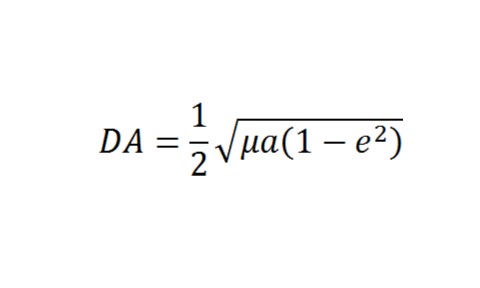
Therefore,

so that finally we have Kepler’s Third Law

Sunday, January 3, 2016
Calculating Orbits: Kepler’s First Law
Kepler’s First Law
Kepler’s First Law tells us that planetary orbits are ellipses. The following derivation, taken from Wiesel, is very clever: it solves a second order differential equation as if by magic. We begin with our second order differential equation, which is an expression for the acceleration of a planet taken from Newton’s Law of Gravity:

We will now cross each side of this equation on the left with the vector $\vec{H}$:

Consider the left side of this equation and note the following

because $\vec{H}$ is constant with respect to $t$.
Now consider the vector portion of the right hand side

By the bac-cab formula

Clearly, $\vec{r}\cdot\vec{r}=r^2$. It is also true that $\vec{r}\cdot\vec{r}=rDr$. This is clear when we resolve $\vec{v}$ into a coordinate system in which $\vec{r}$ lies along one of the axes. It follows that

Therefore,

It is at this point in the derivation that the god comes out of the machine. Note

so

which can be written as

Therefore, the vector whose derivative we’ve taken is constant. Choose the vector $\vec{e}$ so that

and as a consequence

There is yet another god in the machine, however. Dot both sides of this equation with $\vec{r}$ so that

By the application of the triple scalar product, the left hand side may be transformed as follows

If we let $\nu$ be the angle between $\vec{r}$ and $\vec{e}$, the right hand side becomes

Therefore,

and consequently,

Saturday, January 2, 2016
Calculating Orbits: Kepler's Second Law
Kepler’s Second Law
Our aim is to derive Kepler’s Second Law:
The radius from the sun to the planet sweeps out equal areas in equal times.
To put this in language better suited to mathematical manipulation, let $A$ denote the area swept out from time zero to time $t$. Then Kepler’s Second Law saws $DA$ is a constant. We shall show that not only is it a constant but a constant with meaning to physics.
In this derivation, we shall have occasion to use a formula derived from Newton’s Law of Gravity:
The acceleration of a planet is inversely proportional to the square of the distance from the sun and is directed toward the sun.
Mathematically:

or

So

as the angle from $\vec{r}$ to itself is zero and so $\sin \theta =0$. Thus,

Let us also observe that

So that $\vec{r}\times\vec{v}$ is constant. We will denote this constant by $\vec{H}$ and note that

where $\vec{L}$ is angular momentum. We can think of $\vec{H}$ as being angular momentum per unit mass.
Now consider the following diagram of our two-body system as time $\Delta t$ has elapsed.

For small $\Delta t$

so that the altitude of this triangle is $v\sin \theta$ where $\theta$ is the angle from $\vec{r}$ to $\vec{v}$, If $\Delta A$ is the area of this triangle, then

so that
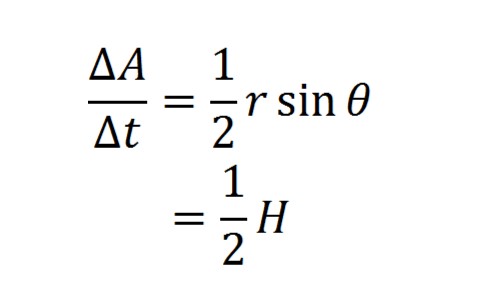
where $H$ is the magnitude of $\vec{H}$.
Therefore,
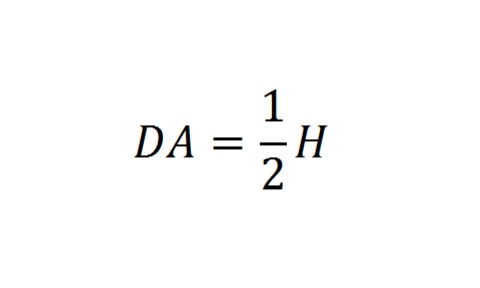
which is Kepler’s Second Law.
Subscribe to:
Posts (Atom)